
By Iqbal Jassat
When Imran Khan was ousted as Prime Minister of Pakistan through a parliamentary vote of no confidence in April 2022, Washington and its allies framed the event as a routine constitutional transition. Yet for anti-imperialist observers, Global South activists, and millions of Pakistani citizens, the removal of Khan looked far less like a simple shakeup in parliament and far more like a familiar geopolitical script.
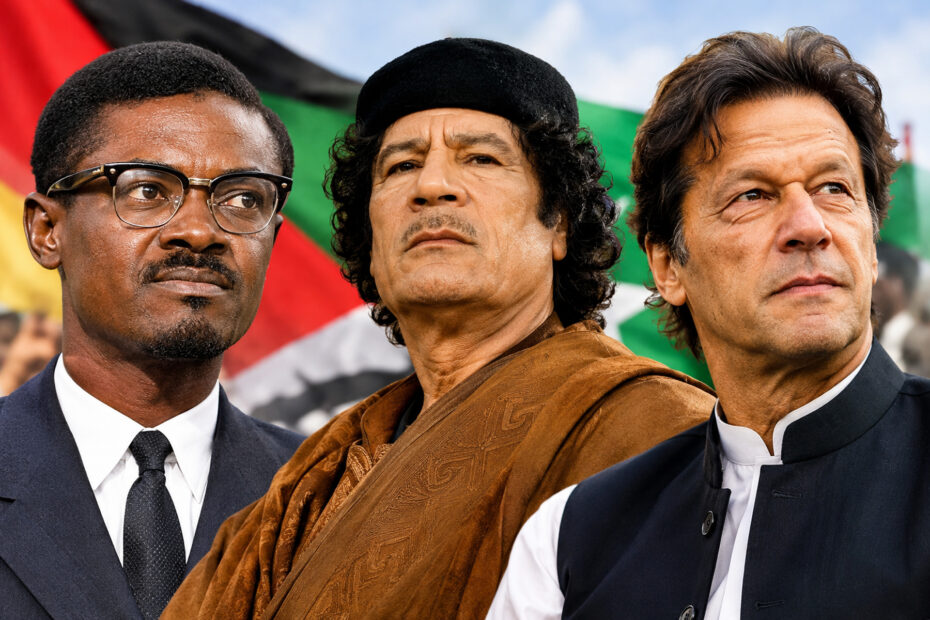
Viewed through an anti-colonial lens, Khan’s ousting fits a particular pattern of American orchestrated regime change. It stretches back to the Cold War assassination of Congo’s Patrice Lumumba to the 2011 NATO-backed violent military overthrow of Libya’s Muammar Gaddafi.
To understand why so many commentators view Khan’s removal as a Washington-choreographed operation, one must examine the tactics that preceded it.
During his tenure, Khan formulated an independent foreign policy that clashed with US priorities. For instance, he rejected Washington’s demands for military bases in Pakistan to conduct operations in Afghanistan, stating “absolutely not” in a widely publicized interview.
At the same time, he deepened economic and diplomatic partnerships with China and sought independent trade and energy agreements with Russia.
The breaking point arrived in February 2022, when Khan traveled to Moscow on the very day Russia launched its invasion of Ukraine—a visit he refused to cancel despite intense Western pressure.
Weeks later, a classified Pakistani diplomatic cable —known as the “cipher” —documented a March 7 meeting between U.S. Assistant Secretary of State Donald Lu and Pakistan’s ambassador to Washington.
According to the leaked cable, published by The Intercept, Lu explicitly linked Pakistan’s future relations with the United States to the success of the impending no-confidence vote against Khan. He warned that if the motion failed, Pakistan would face severe diplomatic isolation, whereas if Khan were removed, “all will be forgiven.”
For critics of American foreign policy, this document serves as a smoking gun. Unlike the overt military invasions of the past, modern regime change relies on financial leverage, diplomatic intimidation, and the activation of compliant domestic elites.
In a country heavily dependent on International Monetary Fund loans and Western financial institutions, Washington’s message to Pakistan’s military and political establishment was unmistakable: remove the defiant Prime Minister, or pay an unbearable economic price.
Supporters of this analysis argue that placing Khan alongside Patrice Lumumba and Muammar Gaddafi reveals how the tools of imperialism adapt while the underlying objective remains constant.
In 1961, Patrice Lumumba, the first democratically elected Prime Minister of the newly independent Republic of the Congo, sought Soviet assistance after Western powers refused to help him quell a Belgian-backed secessionist movement.
Declassified archives later confirmed what anti-colonial movements had long maintained: the CIA and Belgian intelligence actively conspired to remove and assassinate him, installing a compliant dictatorship in his place.
Half a century later, in 2011, Libya’s Muammar Gaddafi met a similar fate. Despite years of diplomatic rapprochement, Gaddafi’s push for pan-African financial independence and a gold-backed African currency threatened Western economic dominance in the region.
When domestic unrest erupted during the Arab Spring, the United States and its NATO allies transformed a limited UN mandate into an all-out aerial campaign for regime change, culminating in Gaddafi’s brutal execution and the collapse of the Libyan state.
From this perspective, the trajectory from Lumumba to Gaddafi to Imran Khan is clear. Where covert assassinations were used in the 1960s and NATO airstrikes in 2011, diplomatic coercion and institutional manipulation were deployed in Islamabad in 2022.
The methods evolved to suit the political terrain, yet the outcome—the removal of an assertive, non-aligned leader—remained identical.
Hence, one must insist that an anti-colonial stance adopted by international solidarity movements will remain incomplete if it overlooks Pakistan.
Recognizing the US hand in choreographing Imran Khan’s removal does not require ignoring Pakistan’s complex internal politics. Rather, it demands acknowledging that true sovereignty in the Global South remains fiercely contested, and that the struggle against external intervention is as urgent in Islamabad today as it was in Kinshasa and Tripoli decades ago.
Iqbal Jassat
Executive Member
Media Review Network
Johannesburg
South Africa