
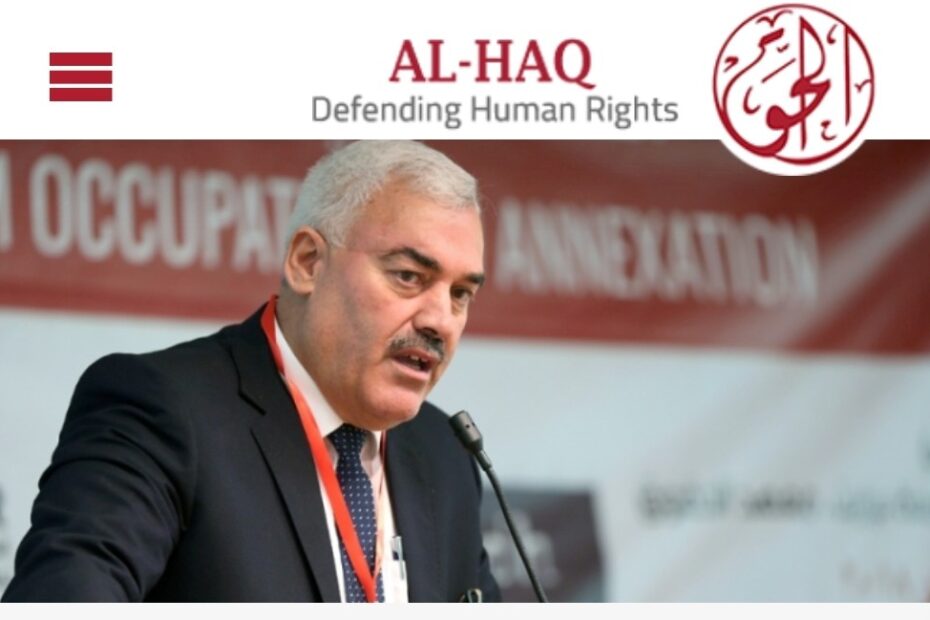
Shawan Jabarin, the general director of the Palestinian human rights organization Al-Haq
By Iqbal Jassat
When a settler-colonial regime fears the truth, its first instinct is to lock the gates. Across occupied Palestine, the systematic imposition of travel bans on human rights defenders is not a bureaucratic mistake — it is a calculated weapon of political suffocation.
For anyone familiar with the dark architecture of South Africa’s notorious apartheid era, the playbook is chillingly recognizable.
The latest victim of this repression is Shawan Jabarin, the general director of the premier Palestinian human rights organization Al-Haq. On November 13, Israeli occupation forces intercepted Jabarin at the Allenby Bridge crossing, interrogated him about his work, and barred him from traveling into Jordan.
Jabarin’s “crime” is identical to the offense that once saw South African dissidents stripped of their passports and slapped with draconian banning orders by the National Party: he documents state crimes and demands accountability before international courts.
For Jabarin, this latest border closure is part of a relentless, decades-long campaign of state intimidation. Between 2006 and 2012, Israel confined him to the occupied West Bank under an arbitrary six-year travel ban justified entirely by “secret evidence”—a ban upheld by Israel’s Supreme Court even when it blocked him from traveling to the Netherlands in 2009 to accept the prestigious Geuzenpenning human rights prize.
In 2022, Israeli intelligence officers threatened him directly with imprisonment if he refused to abandon his advocacy. Now, following Israel’s 2021 outlawing of Al-Haq and 2025 U.S. sanctions targeting the group, the regime is once again slamming the border shut to keep him away from the International Criminal Court.
Jabarin is far from alone. In 2019, Israeli authorities imposed a punitive travel ban on Amnesty International campaigner Laith Abu Zeyad, first denying him a humanitarian permit to accompany his dying mother to cancer treatment in occupied East Jerusalem, and then barring him at the Allenby Crossing from attending a relative’s funeral in Jordan—again citing undisclosed “secret” security grounds that neither he nor his lawyer could see in court.
Similarly, Israeli authorities imposed a de facto travel ban on Boycott, Divestment, and Sanctions co-founder Omar Barghouti by refusing to renew his travel document, openly punishing him for nonviolent political advocacy.
In apartheid South Africa, the white minority state understood that its survival depended on controlling both the physical movement of the indigenous majority and the narrative reaching the outside world.
Through the infamous dompas (passbook) system, influx control laws, and extrajudicial banning orders under the Suppression of Communism Act, Pretoria turned geography into an open-air prison.
Between 1950 and 1990, more than 1,600 anti-apartheid leaders, journalists, and clerics were subjected to banning orders that barred them from entering airports, attending gatherings, or even being quoted in the press.
Consider the parallels.
African National Congress President Chief Albert Luthuli was repeatedly hit with banning orders in the 1950s and 1960s, confining him to his rural magisterial district in Natal to sever him from the national liberation struggle.
Anti-apartheid theologian Dr. Beyers Naudé had his passport confiscated by Prime Minister John Vorster’s government to prevent him from traveling to London to address the Royal Institute of International Affairs, before being silenced under a seven-year banning order.
Prominent freedom struggle icons like Winnie Madikizela-Mandela and Steve Biko were banished to isolated districts or restricted from leaving their towns, all to ensure that the architects of racial domination could operate without witnesses.
Today, apartheid Israel enforces that exact doctrine with ruthless precision.
Palestinians in the occupied West Bank and Gaza live under a suffocating web of color-coded IDs, military checkpoints, and opaque permit regimes that dictate where they can sleep, work, seek medical care, or bury their dead.
When Palestinian human rights defenders attempt to carry evidence of war crimes, land theft, and ethnic cleansing to Geneva, The Hague, or New York, the regime simply seals the exit.
While international monitors—from Human Rights Watch to the Belgian Ministry of Foreign Affairs—have condemned Jabarin’s ban and the broader assault on Palestinian civil society, Israel’s Western enablers largely remain complicit through their silence and punitive sanctions.
A state confident in its legality does not fear a human rights lawyer boarding a flight.
But a regime built on dispossession and racial supremacy cannot survive international scrutiny—so it criminalizes the messengers.
History, however, offers an unmistakable verdict on the futility of such repression.
Pretoria’s banning orders, border closures, and relentless persecution of freedom fighters did not save white minority rule; they only exposed its moral bankruptcy and accelerated its global isolation.
Every time an occupying soldier turns back a Palestinian advocate at a border crossing, it confirms what South Africans and human rights defenders across the globe already know: apartheid is not merely a historical memory—it is an active, ongoing crime in Palestine.
And just as the world eventually dismantled the walls of Pretoria, no travel ban will permanently silence the demand for Palestinian freedom.
Iqbal Jassat
Executive Member
Media Review Network
Johannesburg
South Africa