
By Iqbal Jassat
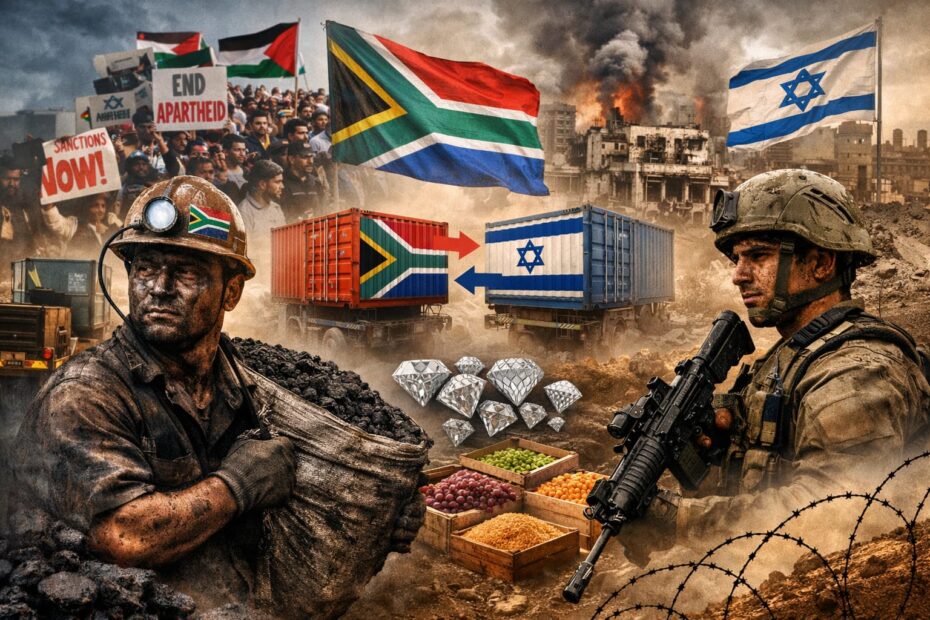
A matter of huge concern for Palestinian solidarity movements in South Africa is the unresolved and extremely troublesome issue of coal exports to Israel.
For many, including trade unions and progressive forces, until a halt is placed on fuelling Israel’s war on Palestinians, the elephant in the room will remain South Africa’s economic lifeline to the Zionist regime.
And the general consensus will be that South Africa’s proclaimed opposition to Israeli apartheid and genocide, “collapses the moment profit is placed above principle”.
The reality of the current status quo is in conflict with the fact that while the government correctly argues genocide at the International Court of Justice (ICJ), South African exports continue to feed the Israeli economy.
Coal, diamonds and strategic commodities flow uninterrupted, sustaining an occupation and war economy that Pretoria publicly condemns. This is not policy incoherence. It is deliberate political theatre masking economic collaboration.
Trade figures drawn from customs data, shipping records and international trade monitoring show that South Africa has quietly deepened its role as a strategic supplier to Israel since late 2024.
When Colombia cut coal exports in protest against Israel’s assault on Gaza, South African producers stepped in. By 2025, South Africa was supplying more than half of Israel’s thermal coal needs, a lifeline for electricity generation during the regime’s genocide in Gaza and ethnic-cleansing in the Occupied Palestinian Territories.
This reality is absent from official speeches. It is reduced to footnotes in parliamentary replies. Instead, government officials invoke World Trade Organization technicalities to justify inaction, insulating private corporations, ports and logistics operators from accountability.
The message is clear. Moral outrage is acceptable so long as it does not interrupt revenue streams.
Predictably, a biased counter narrative will come from Zionist aligned lobby groups and corporate apologists. Sanctions, they will argue, will cost South Africa revenue and jobs. This argument is neither new nor honest.
Market analysts inform us South Africa has already demonstrated that export markets are not fixed.
They remind us that when faced with punitive tariffs under the Trump administration, exporters adapted by diversifying markets and rerouting supply chains. Coal, minerals and agricultural products found alternative buyers.
Did the economy collapse? No.
Surely the same mitigation logic applies here.
Instead of aiding the Zionist regime’s destructive war against Palestinians, alternative economic pursuits in line with South Africa’s principled position at the ICJ are not out of bounds.
They do exist. Coal destined for Israel can be redirected to energy hungry markets across Asia, Africa and parts of Europe.
Indeed, diamonds already circulate through global hubs with ease, and agricultural exports are inherently flexible.
The idea that Israel is an irreplaceable market is a manufactured myth designed to paralyse political will.
Investigative reports to establish who truly benefits from trade with Israel will have no difficulty to identify mining companies, commodity traders, shipping intermediaries and port authorities.
Opponents of South Africa’s genocide case such as the Democratic Alliance (DA) will obviously remain muted. To expect them to lift the lid on corporations profiting from Israel’s energy insecurity, is foolish. Their moral outrage lacks principle. Selective silence cannot be condoned.
South Africa knows this script. Apartheid did not end because it was debated “politely” behind closed doors. It ended because sanctions made the system economically unsustainable. Capital withdrew. Trade routes closed. Labour movements applied pressure where governments hesitated.
You cannot prosecute apartheid abroad while sustaining it through trade at home. Claims of unavoidable revenue loss are excuses, not analysis. Markets can be diversified. What cannot be mitigated is moral failure.
Indeed, to pretend otherwise makes a mockery of South Africa’s groundbreaking legal case.
Iqbal Jassat
Executive Member
Media Review Network
Johannesburg
South Africa