
By RANA AYYUB
From embracing Benjamin Netanyahu to pleading with Iran when the Strait of Hormuz closed, India’s diplomacy in the crisis exposed a troubling loss of strategic autonomy
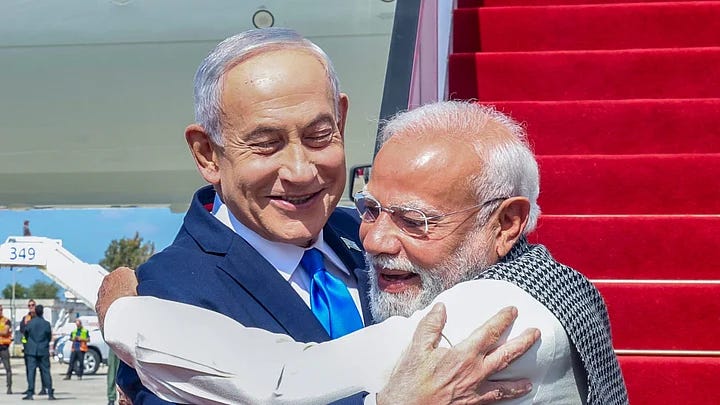
When Narendra Modi stepped off India One, the customised Boeing 777-300ER that had carried him six hours from Delhi, the welcome at Ben Gurion Airport felt almost theatrical. Waiting on the tarmac were Benjamin Netanyahu and his wife, Sara Netanyahu. Modi pulled the Israeli prime minister into two emphatic embraces before Netanyahu laughingly drew attention to the symmetry of the moment: his wife’s saffron dress matched perfectly with the saffron pocket square in Modi’s jacket. It was a small gesture of camaraderie, captured by waiting cameras, in India Modi’s fanclub that comprises of a large population of right wing Hindu nationalists cheered this as the the saffron-Zionist union. Indian Hindu nationalists find common cause with the zionist movement and ironically also with the Zionist Swastika, symbols of religious and caste supremacy.
Netanyahu trended in India that day and the following day when Modi was honoured at the Knesset with a medal that the Haaretz reported never existed before. (https://www.haaretz.com/israel-news/israel-politics/2026-02-27/ty-article/.premium/a-fake-medal-devoid-of-any-substance/0000019c-9bb3-d930-ad9f-fff7cfbe0000)
Modi described Israel as the “Fatherland” and India as the “Motherland,” before suggesting that the two countries were confronting a common enemy and a shared source of terrorism. For anyone familiar with Narendra Modi’s politics, little explanation was needed to understand whom he meant. For two days Modi was feted by Benjamin Netanyahu and even introduced to his family. Yet barely a day after the Indian prime minister returned home, Israeli forces, alongside the United States, launched strikes on Iran that reportedly killed the country’s supreme leader, Ali Khamenei, along with more than 160 children at a local school.
The death toll according to the Irani media from the US-Israeli strikes has now reached 1800.
In diplomacy, timing is substance, symbolism matters almost as much as policy. Which is why the image of Narendra Modi embracing Benjamin Netanyahu on the tarmac at Ben Gurion Airport days before Israeli and American strikes on Iran carries consequences far beyond the choreography of state visits. Even if New Delhi had no foreknowledge of the attack, the symbolism reverberated across West Asia: India appeared visibly aligned with one side on the eve of a regional war.
For decades, India had carefully cultivated a far more delicate balance. It maintained deep strategic ties with Iran even while expanding relations with Israel and the Gulf monarchies. Tehran was not simply another partner; it was central to India’s access to Central Asia, its energy security, and its long-term regional strategy through projects such as Chabahar Port. For much of the post–Cold War period, India prided itself on its ability to speak to all sides in a fractured region.
Yet when the crisis erupted, the public diplomacy from New Delhi told a different story. The Prime minister spoke openly of his conversations with leaders in Israel and the United Arab Emirates, but there was conspicuous silence about Iran. For a country that has long prided itself on maintaining independent relationships across rival camps, the omission was striking even as the Indian right wing celebrated the murder of Iranian civilians and some mainstream news channels that are now an extension of the Modi government referred Iran as a terror state and the Ayatollah as a dreaded, terror figure.
Modi continued to be silent as he travelled across India for election campaigns, his backroom boys in the foreign office scrambling to save face. Modi’s silence reflected a broader shift in India’s foreign policy. In recent years, New Delhi has increasingly avoided taking public positions on major global conflicts. The instinct to play safe, perhaps saying less, can appear safer in a volatile world. But as former national security adviser Shivshankar Menon cautioned, prolonged silence carries its own risks. A country that refuses to articulate positions on the crises shaping the international order eventually finds that its voice carries less weight when it does speak.
In the case of Iran, the costs of that reticence quickly became evident. When hostilities escalated and the vital shipping lanes through the Strait of Hormuz were shut, India suddenly found itself exposed. A significant portion of the country’s energy imports and maritime trade passes through that narrow corridor. Faced with the prospect of disruption, New Delhi reportedly began lobbying Tehran through quiet back channels. A relationship that had been publicly neglected was suddenly urgently needed. According to a report by newschannel, NDTV, “Two Indian-flagged LPG tankers belonging to the Shipping Corporation of India (SCI), the Shivalik and the Nanda Devi, successfully crossed the Strait of Hormuz after intensive diplomatic efforts between New Delhi and Tehran. External Affairs Minister S Jaishankar held four rounds of talks with his Iranian counterpart, Seyed Abbas Araghchi, since the crisis began in late February. On Thursday, Prime Minister Narendra Modi also held high-level discussions with Iranian President Masoud Pezeshkian to secure the safe transit of Indian vessels.”
India did not just have to contend with an embarrassing situation with Iran, it found itself squeezed even by the United States. With the oil crisis hitting India and West Asia, the United States announced that it had “allowed” India to continue purchasing Russian oil ; the language carried an unmistakable implication. India, which has long championed the idea of strategic autonomy, sounded less like an independent power and more like a subservient state seeking exemptions from the United States and Modi’s former best friend, Donald Trump.
Then came the episode that crystallized the contradictions of the moment. The Iranian frigate IRIS Dena, which had recently been a guest of the Indian government, was reportedly torpedoed by American forces during the conflict. During a press briefing, the US defence secretary, Pete Hegseth, appeared almost triumphant as he described the destruction of the Iranian frigate IRIS Dena, remarking that the vessel had assumed it was safe until it met what he called a “quiet death.” That same week, Donald Trump openly celebrated the American military’s approach during the conflict, noting that nearly fifty Iranian ships had been targeted. The plan, he said with a chuckle, was simple: rather than seize them, US forces preferred to sink them.
It was an extraordinary incident: a vessel that had enjoyed the hospitality of the Indian navy was destroyed by a partner nation. Yet New Delhi offered no meaningful public protest.
For a country that aspires to global leadership, the silence was difficult to explain.
India today speaks often of representing the interests of the Global South and reshaping the international order. But leadership requires more than economic growth or military capability. It requires the willingness to speak in moments of crisis, even when doing so is inconvenient.
India once understood this instinctively. Leaders such as Jawaharlal Nehru built the country’s diplomatic standing not merely through alliances but through a willingness to articulate principles in moments of upheaval, from the Suez Crisis to the many crises of the Cold War. Non-alignment did not mean silence. It meant retaining the freedom to speak.
Today that voice appears increasingly muted.
In the weeks following the strikes on Iran, the region watched as India navigated the crisis largely through quiet diplomacy and carefully calibrated statements. The result was a growing perception that India was unwilling, or unable to take a clear position even when its own interests were directly implicated.
Prime Minister Modi often invokes India’s first Prime Minister Jawaharlal Nehru and his alleged historical failures to distract the country, The truth is, Jawaharlal Nehru’s more vocal internationalism offers several clear historical examples of a leader willing to take public positions on global crises, even when India had limited power to influence events. During the Suez crisis of 1956, India used its voice in the United Nations and through the emerging Non-Aligned movement to press for a ceasefire and the withdrawal of foreign troops. He termed the joint attack by Britain, France, and Israel against Egypt as “clear, naked aggression” and a “flagrant violation of the UN Charter”.
Nehru was equally outspoken on the question of Palestine, consistently arguing that the aspirations of the Palestinian people could not be ignored in the shaping of the post-war Middle East, even while India maintained diplomatic relations with Israel. These interventions did not always change the outcome of events, but they helped establish India’s reputation as a country willing to articulate principles in moments of international crisis rather than retreat into silence.
Under Narendra Modi, however, India’s instinct has often been to retreat into studied neutrality. At times, the public narrative around India’s foreign policy appears less shaped by careful diplomacy and more by a noisy ecosystem of hyper-nationalist voices on social media that portray Modi as a global leader universally courted by powerful nations. In June 2025, when the United Nations General Assembly voted on a resolution demanding an immediate, unconditional ceasefire in Gaza Strip and the release of hostages, 149 countries supported the measure. India was among just 19 nations that chose to abstain. That same caution extended to the wider crisis in West Asia.
As tensions escalated into open confrontation with Iran, New Delhi again avoided clear public positions, even when its own strategic and economic interests were directly at stake. The contradiction is hard to miss. India wants the stature of a global power but increasingly behaves like a cautious spectator. Strategic autonomy was supposed to give New Delhi the freedom to stand apart from rival blocs, not the excuse to remain silent when crises unfold. In West Asia today, India has discovered a harsh diplomatic truth: when a country stops speaking in moments of consequence, the region eventually stops listening.