
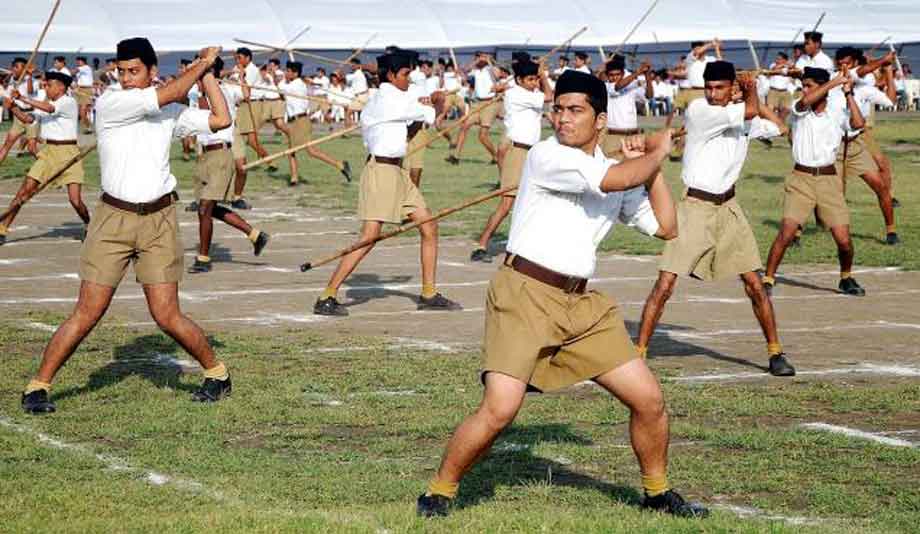
The RSS remains reactionary in a changing India by adhering to a core ideology of Hindu nationalism (Hindutva) that defines Indian identity primarily through a Hindu lens, responding to modernization with an assertion of cultural superiority and traditionalism. Its approach emphasizes the “imagined motherland” over democratic pluralism, using institutional infiltration to counter secularism.
(The Guardian)
There are moments in a nation’s life when institutions must decide whether to evolve with history—or resist it. The Rashtriya Swayamsevak Sangh (RSS), founded in 1925, stands today at precisely such a crossroads. It presents itself as a cultural force committed to national unity and civilizational pride. Yet, beneath this carefully cultivated image lies an ideological framework that many critics regard as deeply reactionary – anchored in a past that no longer corresponds to the ethical and political demands of a modern constitutional democracy.
The question is not whether the RSS has influence—it undeniably does. The question is whether that influence advances India toward a more just, plural, and egalitarian society, or whether it pulls the country backward into a homogenizing and hierarchical imagination of nationhood.
Cultural Nationalism vs. Constitutional Citizenship
At the heart of the RSS worldview is the concept of cultural nationalism—the idea that India is fundamentally a civilizational entity rooted in Hindu traditions. This conception, often articulated through the idea of a “Hindu Rashtra,” has been repeatedly reframed by current chief Mohan Bhagwat to sound more inclusive. Bhagwat has stated that all Indians, irrespective of religion, share a common cultural ancestry.
But such rhetorical accommodation does not resolve the deeper contradiction. India’s Constitution is not built on cultural sameness; it is built on civic equality. Citizenship, as envisioned by the framers, is not contingent upon assimilation into a dominant cultural identity. It is a guarantee of equal belonging.
The RSS framework, however softened in tone, continues to privilege a singular civilizational narrative. Minorities are not always explicitly excluded, but they are often implicitly positioned as needing to adapt, align, or prove their belonging. This is not pluralism; it is conditional inclusion. In a 21st-century democracy, such a framework appears not only outdated but fundamentally incompatible with constitutional morality.
Caste – Harmony Without Justice
The RSS often speaks of social harmony –samajik samrasta – and has undertaken outreach efforts among Dalits and Other Backward Classes. It has, on occasion, condemned untouchability and acknowledged caste discrimination as a social evil.
Yet, the critique persists: the organization does not challenge caste as a system of structural oppression. Unlike B. R. Ambedkar, who called for the annihilation of caste, the RSS tends to frame caste divisions as distortions of an otherwise organic social order.
This distinction is crucial. To seek harmony without justice is to preserve hierarchy while softening its edges. It avoids confronting the redistribution of power, representation, and dignity. It replaces structural reform with symbolic inclusion.
Even today, the upper echelons of the organization reflect a historical dominance of upper-caste leadership. While its base has diversified, power has not been meaningfully democratized. Inclusion, in this context, becomes a strategy of expansion—not transformation.
This is why critics see the RSS approach to caste as profoundly conservative. It does not dismantle inequality; it manages it.
Selective Modernity and the Anxiety of Change
The RSS positions itself as a defender of “Indian values” against what it perceives as excessive Westernization. This posture resonates with many who fear cultural erasure in a globalized world. But it also reveals a deeper discomfort with modernity – particularly when modernity demands a rethinking of entrenched norms.
On questions of gender, for instance, the RSS and its affiliates have encouraged women’s participation in public life, yet often within a framework that reinforces traditional roles. Women are celebrated, but within boundaries- anchored to family, duty, and cultural preservation.
Similarly, on issues like LGBTQ+ rights, the ideological response has been cautious, if not resistant. There is little evidence of a robust commitment to individual autonomy when it challenges inherited social norms.
This is not a rejection of modernity in total—but a selective embrace. Technology, efficiency, and organizational strength are welcomed. But the deeper philosophical shifts—toward equality, autonomy, and rights-based frameworks—are resisted.
Such selectivity is the hallmark of a reactionary worldview: it adapts where necessary, but refuses to transform where it matters.
Manufacturing the “Other”
Perhaps the most troubling dimension of the RSS ecosystem is its relationship with religious minorities, particularly Muslims and Christians. While the leadership often speaks in conciliatory tones, the broader ideological environment has frequently been marked by suspicion, anxiety, and othering.
Campaigns around “love jihad,” cow protection, and religious conversions have contributed to a climate in which minorities are framed as demographic or cultural threats. Even when the RSS formally distances itself from acts of violence, the narratives it helps sustain cannot be divorced from their consequences.
The rise in vigilante violence linked to cow protection, for instance, is not merely a law-and-order issue. It reflects a moral framing in which certain lives are rendered suspect, and certain identities are seen as inherently transgressive.
In a democracy committed to equal citizenship, such a pattern is not just problematic—it is dangerous. It erodes trust, deepens divisions, and normalizes exclusion.
Discipline Over Dissent
The RSS is often admired for its discipline, cohesion, and organizational efficiency. It has built one of the most extensive grassroots networks in the world. But this strength also reveals a weakness.
The organization’s hierarchical structure and emphasis on ideological unity leave little room for internal dissent. Debate, disagreement, and critical reflection—essential components of democratic culture—are subordinated to cohesion and conformity.
In a plural society, the capacity to accommodate difference is not a weakness; it is a necessity. Institutions that discourage internal critique risk becoming rigid, unable to adapt, and ultimately disconnected from the complexities of the society they seek to shape.
An Ideology Frozen in Time
The RSS was born in a colonial context marked by communal tensions and the search for national identity. Its emphasis on unity and cultural assertion must be understood within that historical moment.
But history does not stand still. The India of today is not the India of 1925. It is a constitutional democracy with a deeply diverse population, embedded in a globalized world. The challenges it faces—inequality, social justice, environmental crisis, technological change—require new frameworks of thinking.
Yet, much of the RSS’s ideological core remains anchored in that earlier era. Its emphasis on cultural homogeneity, its suspicion of difference, and its hierarchical social imagination reflects a worldview that has not been fully rethought for contemporary realities.
This is what makes it outmoded – not its age, but its refusal to fundamentally evolve.
Symbolism Without Structural Change
In recent years, Mohan Bhagwat has made statements that appear to signal a shift. He has condemned lynching, spoken against caste discrimination, and emphasized unity across communities.
These interventions are significant – but insufficient in the extreme. The problem is not the absence of progressive statements. It is the absence of consistent, structural change across the wider network of the Sangh Parivar. Incidents of communal tension, caste discrimination, and exclusionary rhetoric continue to surface with troubling regularity.
This gap between rhetoric and reality is where credibility erodes. Symbolism, without transformation, becomes a form of political management rather than genuine reform.
A Clash of Visions
At its core, the debate over the RSS is a debate about India itself.
Is India a civilization that demands cultural conformity, or a republic that celebrates diversity? Is national unity best achieved through homogenization, or through the coexistence of multiple identities? Is social harmony possible without justice?
The RSS offers one set of answers—rooted in continuity, cohesion, and civilizational pride. But critics argue that these answers come at a cost: the marginalization of difference, the preservation of hierarchy, and the erosion of constitutional values.
Conclusion: The Weight of the Past
The persistence of the RSS in India’s public life is a testament to its organizational strength and ideological appeal. It speaks to anxieties about identity, belonging, and cultural continuity in a rapidly changing world.
But strength and relevance are not the same. An ideology that cannot fully embrace equality, pluralism, and justice risks becoming a relic -powerful, yes, but out of step with the moral direction of history.
The RSS does not merely represent tradition. It represents a particular interpretation of tradition – one that, in the eyes of its critics, remains tethered to hierarchy, exclusion, and cultural dominance. In that sense, the charge that it is reactionary is not rhetorical excess. It is a political judgment -grounded in the belief that India’s future cannot be built on ideas that belong, fundamentally, to its past.
Ranjan Solomon has worked in social justice movements since he was 19 years of age. After an accumulated period of 58 years working with oppressed and marginalized groups locally, nationally, and internationally, he has now turned author- researcher-freelance writer focussed on questions of global and local/national justice., Ranjan Solomon has stayed in close solidarity with the Palestinian struggle for freedom from Israeli occupation, and the cruel apartheid system since 1987. Ranjan Solomon can be contacted at ranjan.solomon@gmail.com
https://countercurrents.org/2026/03/why-the-rss-remains-reactionary-in-a-changing-india/