
By Hassen Lorgat
That allegations of a white genocide refuse to die a gentle and quiet death. Will the appointment of the new South African ambassador, an Afrikaner, Roelf Meyer, help to calm the waters, or is this narrative a useful stick to beat a progressive nation?
On April 18, 2026, U.S. President Donald Trump – as if he does not have his hands full – found time to reiterate false claims of a “genocide” targeting white Afrikaner farmers in South Africa. He doubled down on his ambush of President Cyril Ramaphosa from almost a year ago in the White House, repeating that white farmers are being killed because of their race and that their land is being “illegally confiscated.” This line is used to justify special refugee protections, fast-tracked to these former white citizens of Mzansi whom he considers “persecuted South Africans.”
The U.S. embassy website in South Africa spells it out clearly: “the Department of State is coordinating with the Department of Homeland Security to consider eligibility for U.S. refugee resettlement for people who are of Afrikaner ethnicity or a member of a racial minority in South Africa who are victims of government-sponsored race-based discrimination.”
CRITERIA: To be eligible for U.S. refugee resettlement consideration through this initiative, individuals must meet all of the following criteria:
– Must be of South African nationality; and
– Must be of Afrikaner ethnicity or be a member of a racial minority in South Africa.
Note these words, as I will return to them to explain why right-wing white civil society must be held to account. What is clear is that only white Afrikaners were envisaged by Trump’s Executive Order to enter the U.S.
According to data from the Refugee Processing Center as of April 2026, 4,499 refugees were admitted to the U.S. since October 1, 2025, with 4,496 being from South Africa. That represents nearly 99.9% of all admissions. Only three were from Afghanistan.
It is clear that AfriForum has gained from this hot air emanating from the White House. To be fair to AfriForum, they have stated before that they do not regard this episode as a genocide.
During 2024, almost eight months before Trump’s ambush of Ramaphosa in the White House, AfriForum challenged *Sunday World* before the Press Council – and they won. The article was headlined “Moegoe: Afriforum makes noise all the time” (online). The Press Council Ombudsman ruled that *Sunday World* had published “false claims about AfriForum in August 2024” and ordered the publication to retract the allegations and apologise. The August 26 article falsely claimed that AfriForum asserts there is a “white genocide” happening in South Africa, and that the organisation “refuse[s] to cry foul about murders of black people.”
It is because of the vibrancy of our civil society that AfriForum’s pretence to be the spokesperson of all Afrikaners was challenged. “Not in our name” – during October 2025 – pushed back against this narrative.
Months later, in October 2025, dissenting Afrikaners pushed back against Trump’s prostituting of Afrikaner legacies when he said there was a white genocide and that they are being “slaughtered.” The “Not in our name” Afrikaner groups challenged Trump, asserting:
*“We reject the narrative that casts Afrikaners as victims of racial persecution in post-apartheid South Africa. This framing – now being used to support the far-right ‘Great Replacement’ theory in the United States – is not only misleading but also dangerous. It distorts the realities of South Africa, weaponises our history, and reduces a complex social context and necessary levelling of playing fields into a simplistic symbol of white decline.”*
AfriForum and their supporters did not take kindly to this intervention. In a *France24* debate on 17 November 2025, Piet Croucamp, one of the initiators of the open letter, debated Ernst Roets. Roets, a former deputy CEO of AfriForum now with Pax Libertas, challenged the elitist critique against them.
Ernst Roets admitted that Trump communicates through hyperbole, “and what I have experienced – speaking with American journalists who have come to South Africa, one in particular said to me: if the American president didn’t say there was a genocide, I would not have taken interest in the issue in South Africa.” There you have it: the ambiguity. He continued: “I can see that maybe that’s not the correct description of what is happening, but I can see now that there is a very serious crisis in South Africa.” Calling out a genocide or denying one exists is a big thing – but not for AfriForum or Roets. They simply use the denial to tie their wagon to something that borders on substantiating crimes against humanity. Roets, in his own words:
– “Why is this discussion not about the ongoing scourge of farm murders?”
– “Why is this discussion not about senior politicians including the former president chanting ‘kill the boer, kill the farmer’?”
– “Why is this discussion not about the highest court in South Africa saying that politicians can continue chanting about the extermination of minorities?”
– “Why is this discussion not about the fact that there are more than 140 race laws in South Africa?”
– “Why is this discussion not about the fact that the South African government is trying very hard to change the constitution to erode the property rights clause so that they can confiscate private property without compensation?”
– “Why is this discussion not about the land invasions happening in South Africa?”
He ended his interview by accusing the dissenting Afrikaners of being “intellectuals or academics” who spend their time debating the “meaning of genocide” whilst ignoring the real issues. What Afriforum cannot deny is the stats: it is undeniable that the farm murders, lamentable as it is, is a tiny percentage of the total murders in South Africa.
In March 2026, AfriForum’s Kallie Kriel was interviewed on eNCA’s *The People’s Court*. After going back and forth with the host, Kriel admitted that AfriForum does not agree with claims of a “white genocide” in South Africa. He said there is an “attack” on Afrikaners, but not a genocide.
Despite this admission, this information is not easily available on their website – which is surprising for a media-savvy organisation. The site, however, lists its beliefs and commitments. In a section on justice, power abuse, and racism, they explain their aim is to “have justice prevail on various levels. This pursuit of justice extends wider than Afrikaner interests and also includes justice in society as a whole.” But does it? Their charter proudly supports small government and a loud and big civil society, stating:
*“In the spirit of the republican tradition, we believe in government with limited and clearly circumscribed powers, and in a vigorous and active civil society. We reject an excessive civil dependence on the state and believe that people should build their own future through their own efforts and initiative. For this reason, we campaign for the creation of self-reliant and self-respecting communities as the building blocks for a successful Africa.”*
It is from these broad platitudes that we find the gap to push for programmes that advance redress – such as correctly applied affirmative action and diversity that advances women, particularly black African women and those historically disadvantaged. They even take up cases of black victims of government ineptness, but one can see truly who they are.
About two months before Ramaphosa’s visit to the White House, they made excuses for Trump: his comments were about Afrikaners in South Africa as a direct result of President Ramaphosa and his government’s irresponsible actions. They did not say that Trump was wrong. Instead, they said that “AfriForum expressed its great appreciation for Trump and the U.S.’s recognition of the injustice to which Afrikaners are subjected in South Africa.” They ended their statement by once again blaming the government whilst remaining dedicated to the country: “We are still committed to the future of Afrikaners in South Africa and believe urgent solutions are needed to address the injustices caused by the South African government against Afrikaners and other cultural groups.”
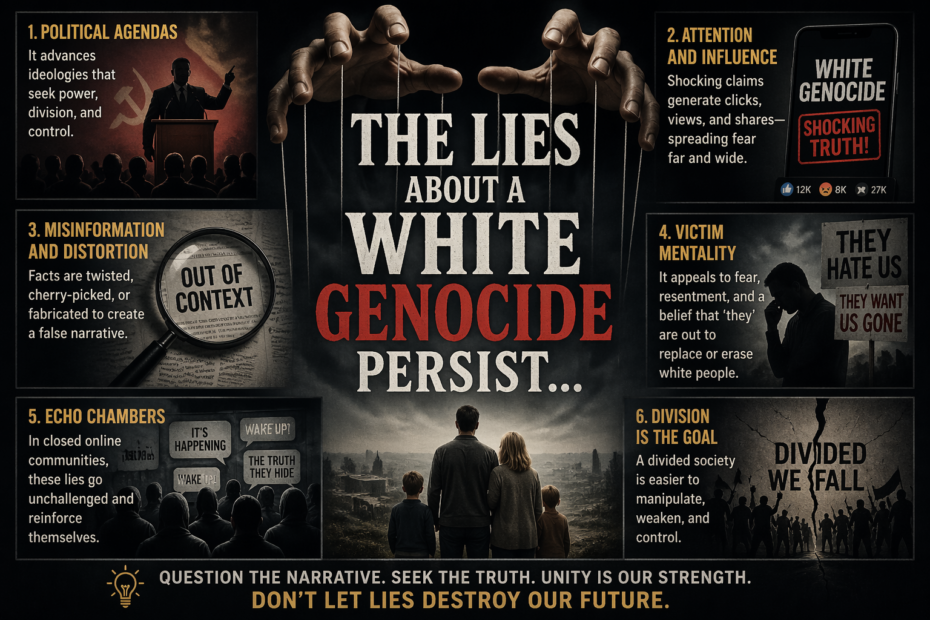
So, why does this genocide lie persist?
There are a few reasons, and it predates Trump but has definitely been amplified by this global agenda against diversity, inclusiveness and equality. It feeds into the great replacement politics playing itself out there. Thus, it serves the Trump agenda and the global right-wing movement that they are part of. This lie is used to weaken – through discrediting – South Africa internationally. And finally, they have used the space provided by the world’s most powerful man – genocide or not – to gain politically. If the push back against their lies is very strong and comes from the government, they can easily resort by arguing that this is proof of the repression and censorship and so on.
This is a dangerous game. By playing the victim, they keep the door open for foreign intervention in our body politic. It may not reach the stage of Venezuela, Cuba or Iran, but it is reckless nevertheless and hides the privilege of those who play this game.
To conclude, I must state that there was sufficient opportunity for AfriForum to state clearly: “There is no white genocide in South Africa.” Instead, they have meandered and played the U.S. public – and Trump in particular. The genocide lie persists not because AfriForum believes it, but because denying it while accepting its political benefits is too useful to abandon.
AfriForum owes South Africa an apology – if not for disinformation, then at least for misinformation. They chose ambiguity over principles, and if this persists overseas, it will continue to fester disharmony at home.