
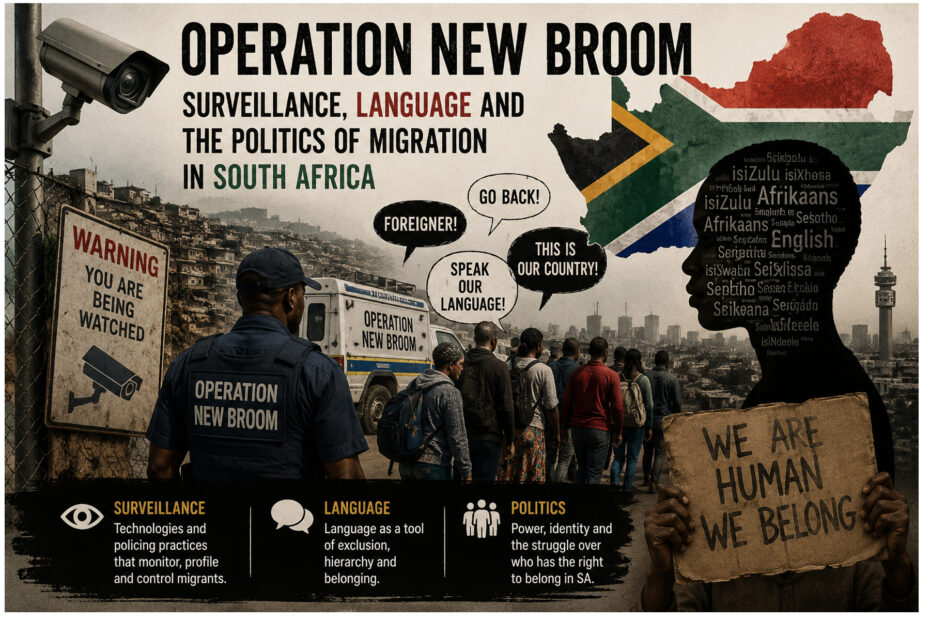
In an era where migration is increasingly managed through data systems and surveillance technologies, the question is no longer only who crosses borders, but how far the state may go in monitoring, categorising, and controlling human movement.
The Department of Home Affairs has launched Operation New Broom, a technology-driven initiative aimed at combating illegal immigration in South Africa. The operation relies on biometric systems to identify individuals and detect fraudulent documentation as part of broader immigration enforcement efforts.
In its initial phase, the operation has reportedly led to the arrest of 25 suspects who were allegedly occupying land illegally in District Six, Cape Town. While officials present such outcomes as evidence of effectiveness, they also raise broader questions about how immigration enforcement operations are being framed and expanded in politically and historically sensitive contexts.
Yet before considering its operational impact, the language of the initiative itself warrants scrutiny. The phrase “New Broom” evokes the idea of sweeping away dirt or unwanted elements. This framing risks reducing migrants and undocumented persons to objects of removal rather than human beings with inherent dignity, rights, and lived experience. At a time when xenophobic sentiment remains a recurring concern in South Africa, language used by the state carries real social consequences.
Words do not merely describe reality — they shape it. When public policy frames migration primarily through the lens of threat and removal, it can reinforce suspicion and deepen social divisions. This sits uneasily alongside South Africa’s constitutional commitments to human dignity, equality, non-discrimination, and ubuntu.
A second concern relates to the operation’s reliance on biometric technology, which introduces significant questions of surveillance and privacy. Home Affairs has provided limited public detail on how the system operates in practice, including whether facial recognition is being used, how biometric data is processed and stored, who has access to it, how long it is retained, and what independent oversight mechanisms exist.
At present, there also appears to be no clear public disclosure identifying the private company or technology provider supplying the biometric infrastructure. This lack of transparency raises additional concerns about accountability in the deployment of sensitive surveillance systems.
These issues are particularly significant given that biometric information constitutes highly sensitive personal data. Section 14 of the Constitution guarantees the right to privacy, while the Protection of Personal Information Act (POPIA) regulates the lawful collection, processing, storage, and sharing of personal information. Unlike passwords or identity numbers, biometric identifiers are permanent and cannot be changed if compromised, increasing the stakes of any misuse or data breach.
Civil society organisations and privacy experts have long warned that surveillance technologies, once introduced, tend to expand in scope and application over time. In different global contexts, including systems of population monitoring in occupied Palestine, biometric and digital surveillance infrastructures have been used to normalise extensive tracking of civilian movement. These examples are frequently cited by digital rights researchers as warnings about how surveillance tools introduced for administrative or security purposes can evolve into broader systems of control if not subject to strong legal safeguards and transparency.
The broader immigration debate should also be informed by evidence rather than fear. Research by international organisations such as the International Organization for Migration and the World Bank consistently shows that migrants contribute to economic activity, entrepreneurship, skills development, and labour markets in host societies. In South Africa, migrants participate in small business creation, service delivery, and community life, often under precarious conditions. Reducing migration to a security issue risks obscuring these contributions and deepening social fragmentation.
More fundamentally, debates about borders and belonging require historical context. Many of the borders that define modern African states were drawn during the colonial era, often with little regard for existing cultural, linguistic, and economic realities. Communities that had long interacted were divided by lines imposed externally, reshaping identities and mobility across the continent.
This history does not negate the existence of modern states or the legitimacy of immigration regulation. However, it does underscore that borders are human-made constructs rather than natural divisions between people. As such, they should not become barriers to empathy, dignity, or solidarity.
Immigrants are not invaders. They are workers, entrepreneurs, students, parents, refugees, and individuals seeking safety and opportunity. In a country shaped by its own history of forced displacement and inequality, there is a particular responsibility to resist narratives that dehumanise migrants or treat them as disposable.
South Africa’s future will not be secured through fear, exclusion, or unchecked surveillance. It will be secured through constitutionalism, transparency, accountability, and a commitment to shared humanity. In a continent defined by movement and interconnected histories, the answer is not to sweep people away, but to uphold the dignity of all who call Africa home.
Sõzarn Barday is a South African lawyer and author focusing on human rights, international law, and geopolitical events in the Middle East. The views expressed are her own.