
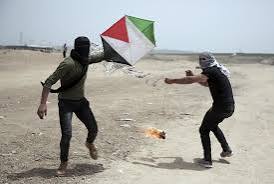
“A Palestinian child’s pastime is now treated as a capital offense by the genocidal regime”
By Iqbal Jassat
In a conflict already defined by staggering asymmetry, the latest threat from the settler colonial regime’s war criminals Benjamin Netanyahu and Israel Katz pushes past the boundaries of strategic warfare into the realm of the dystopian.
To threaten the mass evacuation of entire neighborhoods in Gaza and step up targeted killings over paper kites is a terrifying escalation. It is a punitive policy directive that the United Nations human rights office rightly condemned as “outrageous.”
The facts on the ground, confirmed by Israel’s own military apparatus, expose the profound emptiness of this security pretext. The ten paper kites that drifted across the Gaza border into southern Israeli border communities contained no explosives, carried no suspicious materials, and posed absolutely no threat to public safety.
They were toys, flown by children looking for a fleeting moment of ordinary childhood among the ruins of their devastated homes.
Hamas officials have actively supported this perspective, framing the kites not as weapons, but as a symbolic cry for freedom. Hamas political bureau member Bassem Naim publicly defended the children, stating they were merely searching for their “innocent childhood amid the rubble.”
By backing the kite flying, Hamas has highlighted the stark contrast between harmless children’s toys and the overwhelming military might deployed by Israel, accusing the Israeli government of using a harmless pastime as a manufactured pretext for further military escalation.
Treating a child’s toy with the same military response as an armed combat drone is a deliberate distortion of reality. It serves to manufacture a threat where none exists to satisfy a political narrative. This rhetoric does not reflect a legitimate state defense; it is a calculated strategy to justify collective punishment.
By threatening to displace entire populations based on the actions of children, the Israeli leadership demonstrates an utter contempt for international humanitarian law.
Under international legal frameworks, collective punishment is an absolute red line that cannot be crossed under any military justification.
Article 33 of the Fourth Geneva Convention explicitly states that no protected person may be punished for an offence he or she has not personally committed.
Furthermore, Article 49 strictly prohibits the individual or mass forcible transfer of populations within or from occupied territory, regardless of the motive.
By threatening mass expulsions over the actions of anonymous children, Israel’s directives violate these core tenets. It shifts the burden of guilt from individual actors to an entire civilian populace, transforming mandatory evacuations into an illegal tool of demographic engineering and systemic intimidation. This logic effectively criminalises existence itself, turning the geography of Gaza into a zone of permanent liability.
Because these actions threaten the very fabric of global law, nations with a historical memory of systemic oppression have a profound legal and moral duty to intervene. Countries like South Africa, which successfully dismantled an apartheid regime rooted in forced removals, racial segregation, and the criminalisation of daily life, carry a unique moral authority on the global stage.
South Africa’s post-apartheid foreign policy is anchored in the promotion of human rights and the prevention of state-sponsored dispossession. For Pretoria, opposing Israel’s repression is not just an optional geopolitical stance; it is a direct continuation of its own liberation struggle. South Africa’s ongoing legal interventions at the International Court of Justice (ICJ) demonstrate its commitment to ensuring that international humanitarian frameworks apply equally to all nations, without exception.
Nations that have survived institutionalised state terror understand that when the international community tolerates the collective punishment of one people, it weakens the legal protections of all people everywhere.
To look away now is to validate a dangerous precedent where a genocidal nuclear regime can rewrite international law to suit its immediate military desires.
The consequences of global silence and diplomatic inertia are already tragically real. While political leaders debate the security threat of paper kites, Israeli airstrikes continue to hit central Gaza, recently claiming the life of a four-year-old child.
The disparity could not be more stark or devastating: children flying kites on one side, and state-sponsored airstrikes killing toddlers on the other.
Gaza’s local popular committees have been forced to urge parents to stop their children from flying kites, hoping to shield them from becoming military targets. It is a damning indictment of the current state of affairs that a child’s pastime is now treated as a capital offense.
The international community must look past the security rhetoric and see this threat for what it is: an attempt to normalize the collective punishment of an entire population. If the world stands by and allows paper kites to justify mass expulsions, it signals that no pretext is too small, and no human right is too sacred to be discarded.
Iqbal Jassat
Executive Member
Media Review Network
Johannesburg
South Africa