
By Sõzarn Barday
A bottle of water appears to be one of the simplest commodities in the world. It is portable, readily available and, in many places, inexpensive. But in Palestine, the economics of drinking water cannot be separated from a much larger question: what happens when access to safe water becomes uncertain and households are increasingly dependent on alternative sources?
The answer is that water acquires a different economic value. It becomes something that must not only be supplied, but purchased, treated, transported and distributed through systems outside ordinary public infrastructure.
The economics of water in Palestine is therefore not simply a story about bottled water. It is a story about the cost of accessing a basic resource — and the relationship between that cost and the human right to water.
According to the Palestinian Central Bureau of Statistics (PCBS), Palestine had approximately 396.1 million cubic metres of available water in 2023. This included groundwater, springs, desalinated water and approximately 98.5 million cubic metres purchased from Israeli water companies. Yet the existence of water resources does not necessarily translate into equal access to safe water.
In 2023, 245.4 million cubic metres were supplied to the domestic sector, while 93.1 million cubic metres were recorded as losses. Average daily consumption was 79.8 litres per person. In the West Bank, approximately 60% of water supplied for domestic use was purchased from Israeli water companies.
This is where the economics becomes important.
Water is not simply a natural resource. It is also an infrastructure-dependent commodity. Its cost can be affected by its source, treatment, transportation, energy requirements, infrastructure and access to distribution networks.
Nowhere is this more evident than in Gaza.
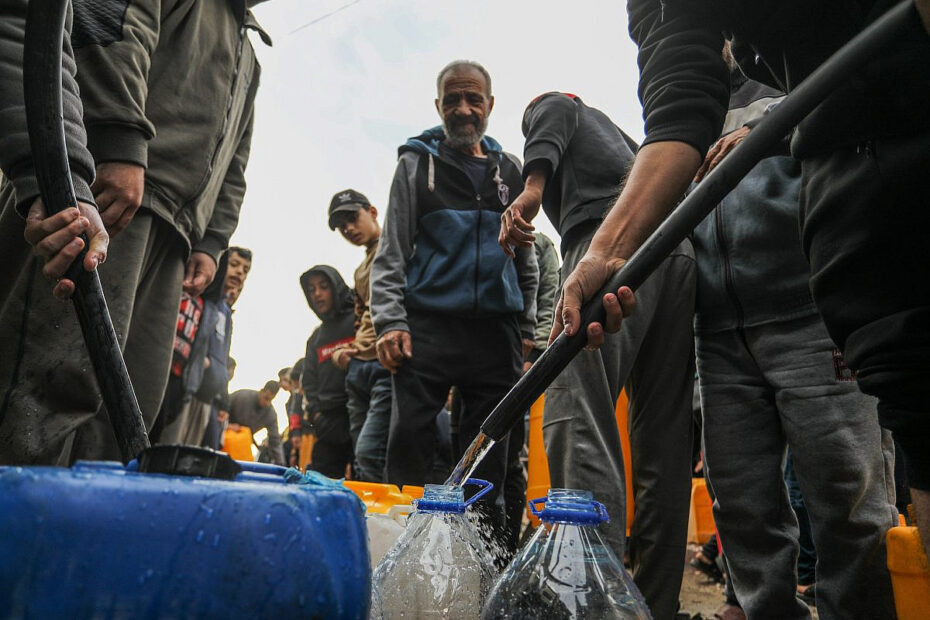
When water becomes an emergency commodity
The disruption and destruction of water infrastructure have dramatically altered the economics of water in Gaza.
PCBS reported that the price of drinking water distributed by tankers increased from approximately 30 shekels per cubic metre in 2023 to 160.4 shekels in 2024. The price of 500 litres increased from approximately 17 shekels to 80.2 shekels. PCBS described the increase as more than 400%, noting that fresh water had become a scarce and expensive commodity that placed additional pressure on households.
The significance of these figures extends beyond the price of a tanker.
Unlike many consumer goods, drinking water is difficult to substitute or simply stop purchasing. A household can postpone buying clothes or entertainment. It cannot indefinitely postpone drinking water.
Water therefore has an unusual economic characteristic: demand remains high because the underlying need is essential.
When supply becomes disrupted, the price can rise sharply without eliminating demand.
The hidden cost of moving water
The price of water is also affected by geography.
In Gaza, damaged or destroyed distribution networks have increased reliance on water trucks and desalination. The International Committee of the Red Cross reported in June 2026 that much of the infrastructure needed to clean, store and distribute water remained damaged or destroyed, while electricity and fuel shortages continued to affect water production and distribution.
This illustrates an important economic principle: the cost of water is not necessarily determined by the cost of the water itself.
Transport, fuel, electricity, infrastructure and distance can all become part of the final cost.
A litre of water produced close to a community and delivered through functioning pipes is economically different from a litre that must be desalinated, transported by truck and delivered to a displaced population.
The water may be physically identical.
The economics are not.
The international law of water
But water in Palestine is not only an economic issue. It is also a legal one.
The United Nations Committee on Economic, Social and Cultural Rights has recognised the human right to water under the International Covenant on Economic, Social and Cultural Rights. General Comment No. 15 describes the right as an entitlement to water that is sufficient, safe, acceptable, physically accessible and affordable for personal and domestic uses.
Affordability is particularly significant when considering the economics of water.
International human rights law does not treat access to water as satisfied merely because water exists somewhere or can theoretically be purchased. The standard includes affordability and accessibility.
This creates an important distinction between having a water market and having meaningful access to water.
If a household can technically purchase water but the price has increased dramatically while household resources remain limited, the existence of a market does not necessarily resolve the underlying question of access.
International humanitarian law adds another layer of protection during armed conflict.
The Fourth Geneva Convention contains obligations concerning the basic needs of the population of occupied territory. In a 2025 advisory opinion, the International Court of Justice stated that an occupying power is required to ensure that the population of the Occupied Palestinian Territory has essential supplies of daily life, including water, and to facilitate humanitarian relief when the population is inadequately supplied. The Court also affirmed that Israel’s obligations under international human rights law apply to the population of the Occupied Palestinian Territory.
The ICJ had already addressed water specifically in its 2024 advisory opinion concerning Israel’s policies and practices in the Occupied Palestinian Territory. The Court concluded, on the evidence before it, that severely restricting Palestinian access to water available in the Occupied Palestinian Territory was inconsistent with Israel’s obligations under international law.
These legal principles matter economically because they challenge the idea that access to water can be understood solely as a matter of supply and demand.
Water is a commodity in an economic sense, but it is also connected to legally protected rights and obligations.
Bottled water is only one part of the market
It would therefore be misleading to examine Palestine’s water economy exclusively through commercially bottled water.
Alternative water markets include tanker deliveries, privately operated desalination plants, purchased network water and humanitarian water provision.
PCBS recorded approximately eight million cubic metres of desalinated drinking water in 2023 and identified the relevant desalination plants as privately owned.
The distinction between “bottled water” and emergency water can consequently become blurred. Both involve treating water as something that must be processed, packaged or transported outside conventional public networks.
The broader question is therefore:
When does a public water shortage create a private water market — and what happens when people cannot afford that market?
Who ultimately pays?
The economic burden does not fall on one actor alone.
Households may pay directly for water. Humanitarian organisations may purchase or subsidise water from suppliers. Governments and international organisations may finance infrastructure, desalination, fuel and emergency distribution.
The ICRC has reported supporting water trucking, desalination units, wells and repairs to water infrastructure in Gaza.
This means that the economic consequences of water insecurity extend far beyond the price printed on a bottle.
There is the cost of fuel, electricity, treatment, transportation, infrastructure repair and emergency humanitarian operations.
Water insecurity therefore creates a chain of economic costs.
From public utility to commodity
Water has traditionally been treated as a public utility because of its essential role in human life. Yet when public infrastructure cannot reliably provide sufficient safe water, households and humanitarian organisations are pushed towards markets and alternative suppliers.
Private providers can play an important role where public infrastructure is damaged or unavailable. But the existence of a private market does not eliminate the underlying question of affordability.
The Palestinian case demonstrates how the price of water can reflect much more than the value of the liquid inside a bottle.
It can reflect infrastructure, energy, transportation, desalination capacity, access to resources and the physical difficulty of moving water to people who need it.
It can also reveal the gap between a right recognised in international law and the economic reality of exercising that right.
The economics of water in Palestine is therefore ultimately an economics of access.
A bottle may contain only a few litres of water. But the price attached to those litres can reveal the much larger economic cost of a system in which access to safe water increasingly depends on purchasing, transporting and privately or humanitarianly distributing a resource essential to human life.
The question is consequently not simply “How much does a bottle of water cost?”
It is:
What happens when access to a human necessity increasingly depends on the ability to pay for it?
Sõzarn Barday is a lawyer and author who writes on human rights, international law and public policy. The views expressed are her own.