
Some obscenities are so stark that no language of diplomacy can disguise what they are.
For three years, Gaza was pulverized before the eyes of the world. Children were pulled from concrete. Hospitals became killing grounds. Hunger was weaponized, displacement normalized, and an entire people subjected to destruction while the Muslim world’s most powerful regimes perfected the politics of the communiqué.
There were summits, emergency meetings, solemn speeches and declarations of “grave concern.” There were rulers posing as guardians of the ummah while discovering, with astonishing consistency, that every meaningful form of pressure on Israel was somehow too dangerous, too escalatory, too impractical.
There were armies everywhere.
Just never for Gaza.
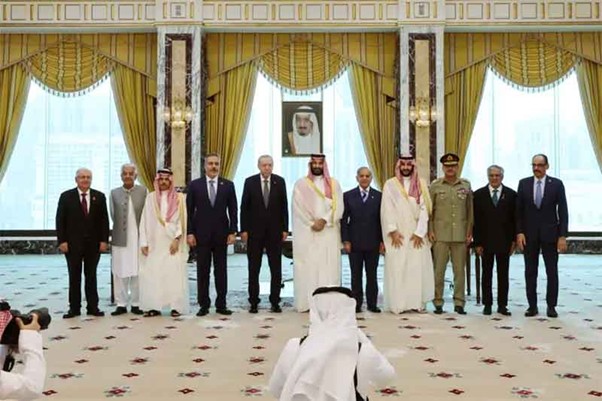
Then Saudi Arabia came under attack, and suddenly restraint vanished. Pakistan, Saudi Arabia and Türkiye moved from the ceremonial language of the Mecca Joint Defence Agreement toward actual military implementation, including the rapid deployment of forces and capabilities to the kingdom.
The Muslim world had finally found a cause worth mobilizing for.
Against Yemen.
Against Ansar Allah.
Against the force that, almost alone among governments and armed movements in the region, was willing to impose actual costs over the slaughter of Palestinians.
That is the obscenity.
When Gaza screamed, powerful Muslim states issued statements. Ansar Allah acted. It disrupted shipping, absorbed American and Israeli strikes, endured extraordinary retaliation and continued insisting that the genocide of Palestinians could not simply proceed as though the rest of the region were scenery.
Whatever Riyadh, Washington or Tel Aviv may call them, millions across the Muslim world understood the moral contrast perfectly: those possessing the least were prepared to risk the most, while governments sitting atop enormous armies, vast oil wealth and decades of Western weaponry could scarcely summon anything more dangerous than another press release.
And now Pakistan may help attack the people who refused to remain spectators.
Pakistan, of all countries, should remember where this road leads.
In 2015, Saudi Arabia asked Islamabad for aircraft, warships and troops for its Yemen war. Pakistan’s parliament debated the request and unanimously chose neutrality. It pledged to defend Saudi territorial integrity and the holy places, but refused to become an expeditionary arm of Saudi foreign policy.
That distinction was not cowardice. It was sovereignty.
Eleven years later, Islamabad appears determined to erase it.
The Mecca pact was originally wrapped in the soothing language governments use when they would rather nobody inspect the machinery too closely: deterrence, solidarity, collective security. Because its operational provisions remained opaque, many assumed it functioned like geopolitical health insurance — protection against future emergencies, not coverage for Saudi Arabia’s pre-existing Yemeni condition.
Apparently we misunderstood the policy.
The insurer now seems prepared to cover the pre-existing condition.
And this time there has been no great parliamentary debate comparable to 2015. Pakistanis are left asking elementary questions their rulers appear curiously uninterested in answering. How many troops? Under whose command? Defending what? For how long? Does “defence” stop at intercepting missiles over Saudi territory, or does it crawl, as wars always do, toward intelligence support, targeting assistance and attacks inside Yemen?
These are not procedural details. They determine whether Pakistan is defending an ally or entering another man’s war.
They also threaten one of Islamabad’s most important recent diplomatic achievements: rebuilding trust with Iran. Pakistan has spent 2026 presenting itself as a regional mediator, cultivating Tehran and advertising its ability to speak credibly across rival camps.
That credibility can disappear in an afternoon.
If Pakistani military power becomes part of a Saudi campaign against Ansar Allah while Riyadh moves deeper into an American-Israeli regional security architecture confronting Iran, Tehran will reasonably ask what Pakistan’s professions of neutrality were ever worth.
And Pakistan’s own people may ask something harsher.
Why were Pakistani soldiers unavailable when Palestinians were being annihilated, yet potentially available when Yemenis who acted for Palestine became the enemy?
Why was escalation intolerable against Israel but suddenly manageable against Ansar Allah?
Why did Gaza require patience, diplomacy and restraint while Saudi security requires aircraft and troops?
The contradiction is no longer merely embarrassing. It is morally grotesque.
Professor Seyed Mohammad Marandi recently recalled Imran Khan’s question during the original Yemen crisis: “Has Pakistan not suffered enough by participating in others’ wars?”
Eleven years later, the question has acquired an accusation.
Pakistan has repeatedly confused strategic rent with strategic interest: entering conflicts designed elsewhere, receiving short-term rewards and inheriting consequences that last for generations. Its rulers continually imagine that subcontracting Pakistani military power will somehow increase Pakistani sovereignty.
It does the opposite.
Sovereignty means deciding which wars are yours.
In 2015, Pakistan still understood that.
In 2026, it risks becoming the military subcontractor of regimes that watched Gaza burn, discovered no collective-defence obligation toward Palestinians, and then miraculously rediscovered Muslim solidarity when Ansar Allah made Saudi Arabia uncomfortable.
The final irony is almost too ugly to improve with rhetoric.
Pakistan refused the Yemen war once.
Now, after Gaza, it may join it — not against those who perpetrated the slaughter of Palestinians, but against those who were willing to act while the Muslim world’s palaces watched, spoke, mourned and did nothing.