
By Iqbal Jassat
It is a truism that for decades, South Africa has wrestled with the recurring demon of xenophobia. Periodically, our townships and cities erupt in violence directed at fellow Africans and South Asian nationals—a tragic symptom of deep-seated socioeconomic frustration, inequality, and a fractured post-apartheid healing process.
Yet, as the digital landscape evolves and global geopolitical fault lines shift, a more insidious, overlapping prejudice has quietly become visible alongside traditional anti-foreigner sentiment: contemporary Islamophobia.
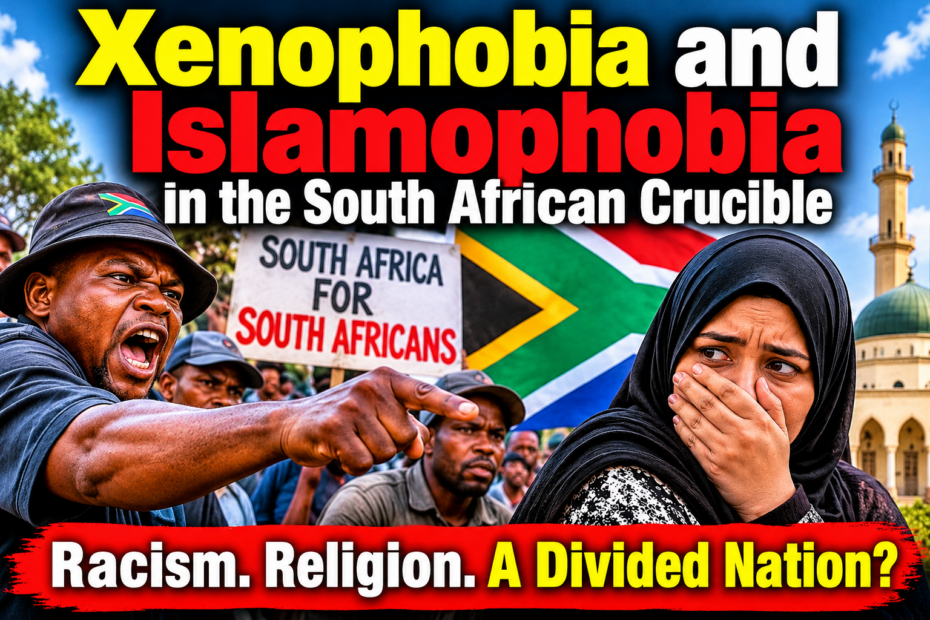
To understand the current state of intolerance in South Africa, one can no longer look at xenophobia and Islamophobia as separate sicknesses. Instead, they have become deeply intertwined, feeding off the same anxieties regarding resources, identity, and who truly belongs in the country.
At the heart of xenophobia is the weaponisation of the “outsider” narrative. For years, asylum seekers, undocumented migrants and cross-border traders have been scapegoated for systemic failures—ranging from high unemployment to inadequate service delivery.
When these targeted communities happen to be visibly Muslim—such as Somali refugees in Cape Town, Pakistani or Bangladeshi shopkeepers in Johannesburg, or Malawian mechanics in Durban—the nature of the prejudice shifts.
Suddenly, the economic resentment of xenophobia is supercharged by the cultural and civilisational anxieties of Islamophobia. The migrant is no longer just accused of “taking local jobs”; they are painted as an existential threat to the secular or Christian fabric of the community.
In the crucible of local communities, the Somali tuck-shop owner is targeted not only because he is a foreign national, but because his visible religious identity is easily framed through a lens of suspicion and stereotyping.
This intersection is not purely accidental; it is being actively manufactured. In recent years, local civil society watchdogs and digital researchers have noted a marked increase in coordinated online disinformation campaigns within South Africa.
These campaigns frequently import global, right-wing Islamophobic tropes—narratives of “demographic replacement,” radicalisation, and underground networks—and graft them directly onto existing anti-immigrant rhetoric.
By framing the influx of African and Asian migrants as an “Islamic takeover,” populist political actors and online provocateurs find a highly effective tool to stoke fear, consolidate conservative bases, and distract from complex domestic governance failures.
The tragic irony of this rising tide is how violently it clashes with South Africa’s own history. Islam is not a foreign import of the post-1994 democratic era. The roots of Islam in South Africa run deep into the soil of our liberation struggle, brought to these shores over three centuries ago by political exiles and enslaved people from the Indonesian archipelago, and later by indentured labourers from South Asia.
From the anti-apartheid activism of the Muslim Judicial Council, Call of Islam, Qibla, Muslim Youth Movement and figures like Imam Abdullah Haroon to the wide range of welfare and relief organisations, South African Muslims have been foundational to the country’s social, political and democratic fabric.
Yet, when global geopolitical tensions flare—whether via the legacy of America’s illegal War on Terror or sparked by the insane, and inhumane oppression by the apartheid Israel regime against Palestinian Muslims and Christians, the obvious natural response by solidarity movements is unfairly profiled as “Islamic Radicalism”.
South Africa’s vocal, principled stance on international human rights, particularly its solidarity with the Palestinian cause and ties to the Islamic Republic of Iran, has deliberately been scapegoated by a variety of so-called “think tanks” and rightwing NGOs.
Consequently, South African Muslims find their patriotism questioned, facing accusations of dual loyalty or harboring extremist sympathies, effectively transforming a deeply rooted domestic community into “perpetual foreigners” in the public imagination.
Confronting this dual menace requires a holistic shift in how South Africa addresses social cohesion. We cannot effectively combat xenophobia while remaining blind to the religious prejudices that weaponise it.
Conversely, we cannot dismantle Islamophobia without addressing the structural inequality and border-management anxieties that drive anti-foreigner sentiment.
South Africa’s constitution promises a society built on human dignity, equality, and freedom. To safeguard that promise, civil society, religious leaders, and political formations must recognise that hate is rarely compartmentalised.
When we allow the borders of belonging to be narrowed by xenophobia, we inevitably pave the way for Islamophobia and other forms of bigotry to take root.
In the end, defending the rights of the migrant, the refugee, and the religious minority is not an act of charity; it is the ultimate defense of our own democratic experiment.
Iqbal Jassat
Executive Member
Media Review Network
Johannesburg
South Africa