
By Sõzarn Barday
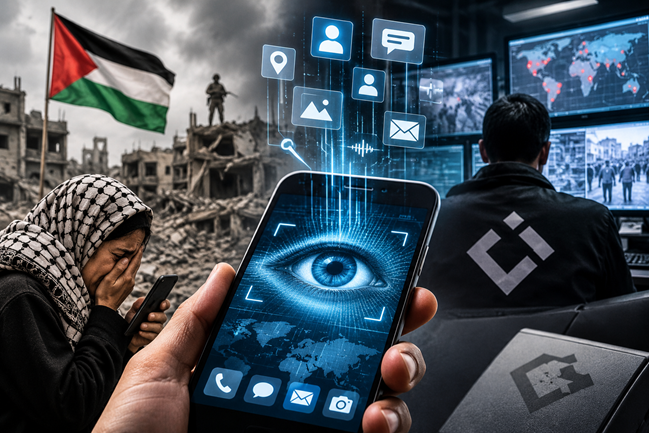
Your phone knows who you love, where you sleep, what you believe and who you speak to. It holds fragments of your identity that you might never willingly share with another person. But what happens when those private details become accessible to an intelligence agency? For Palestinians living under Israeli occupation, digital surveillance raises a deeply troubling question: when does collecting information become a weapon of oppression?
A mobile phone is no longer simply a communication device. It is a digital record of someone’s life, containing private conversations, photographs, location histories, personal relationships and sensitive information. In the wrong hands, that information can become a powerful instrument of surveillance, intimidation and control.
One company operating within this global surveillance industry is Cellebrite, an Israeli-founded digital intelligence company specialising in the extraction and analysis of information from electronic devices. Its technology helps law enforcement and investigative organisations retrieve digital evidence that may otherwise be difficult to access.
The company publicly emphasises privacy, transparency, public safety and respect for individual rights. It also states that its customer screening procedures consider human rights records and that customers violating its licensing conditions may lose access to its products and support. These commitments raise an important question: how effectively can such safeguards be independently scrutinised?
The surveillance of an occupied population
The wider Israeli surveillance apparatus cannot be examined independently of the occupation of Palestinian territory. Palestinians have long faced restrictions on movement, extensive monitoring and serious concerns about interference with their fundamental freedoms.
Israel’s Unit 8200, its military signals intelligence division, has attracted scrutiny following allegations concerning the collection and exploitation of Palestinians’ private information.
In 2014, former members of Unit 8200 publicly criticised its surveillance practices. They alleged that sensitive information, including details concerning medical circumstances, sexual orientation and personal relationships, could be used to pressure Palestinians into becoming informants.
Such allegations illustrate how surveillance can extend beyond intelligence gathering. When personal vulnerabilities become instruments of pressure, privacy becomes inseparable from dignity, freedom of expression and personal autonomy.
Cellebrite’s commercial activities should not, however, be conflated with Unit 8200’s operations. There is no established evidence presented here that Cellebrite supplied the unit with the technology involved in these allegations. The concern is broader: what responsibilities should technology companies bear when their products can be used by powerful institutions in environments where human rights are already under threat?
When artificial intelligence enters the battlefield
The relationship between intelligence gathering and military operations becomes particularly troubling when artificial intelligence is introduced into target identification.
In April 2024, an investigation by +972 Magazine and Local Call reported on the alleged use of an Israeli military AI system known as Lavender during the war in Gaza.
According to the investigation, the system analysed intelligence information and identified approximately 37,000 Palestinians as potential targets based on suspected associations with Hamas or Palestinian Islamic Jihad. Israeli intelligence officers interviewed by the publications alleged that human verification was sometimes reduced to approximately 20 seconds per proposed target.
The investigation also reported that military officials had permitted significant civilian casualty thresholds in certain circumstances. These were allegations attributed to the officers interviewed. The Israeli military disputed the characterisation of its targeting procedures and maintained that human analysts independently assess targets.
The legal implications are significant. International humanitarian law requires parties to distinguish between civilians and combatants, assess proportionality and take feasible precautions to minimise civilian harm.
An algorithm cannot independently determine whether an individual is a lawful military target. A numerical score is not proof of direct participation in hostilities, and technological sophistication does not remove the obligation to protect civilians.
Ultimately, responsibility remains with the people and institutions authorising military operations. Artificial intelligence cannot become an excuse for unlawful conduct.
The legal question: Can corporations remain neutral?
This is where Cellebrite presents a particularly interesting legal question.
The United Nations Guiding Principles on Business and Human Rights establish that companies have a responsibility to respect internationally recognised human rights. This includes identifying, preventing and mitigating adverse human rights impacts connected to their operations and business relationships.
For surveillance companies, this responsibility demands more than a general statement about ethical technology. It requires meaningful consideration of who receives their products, how those products may be used and what happens when credible allegations of misuse emerge.
Cellebrite states that its customer screening procedures consider human rights records and that it can withdraw product support from customers who breach its licensing conditions. These are important commitments, but they also invite further scrutiny: how transparent are these assessments, how frequently are they reviewed, and what independent oversight exists?
The distinction between corporate responsibility and criminal liability is essential. A company is not automatically criminally responsible for every abuse committed by a customer using its products. Establishing complicity in international crimes would require evidence satisfying the applicable legal requirements, including relevant knowledge and contribution thresholds.
Nevertheless, commercial activity does not exist outside the reach of human rights standards. A company cannot treat the foreseeable consequences of its products as irrelevant simply because it does not directly conduct military operations.
What the International Court of Justice changes
The legal context became particularly significant following the International Court of Justice’s advisory opinion of 19 July 2024.
The Court concluded that Israel’s continued presence in the Occupied Palestinian Territory is unlawful and that Israel is under an obligation to bring that presence to an end as rapidly as possible. It also addressed the responsibilities of other states, including their obligation not to recognise as lawful the situation arising from Israel’s unlawful presence and not to render aid or assistance in maintaining it.
Although the opinion concerns state obligations rather than establishing automatic liability for private corporations, it has important implications for businesses operating in or connected to the occupied territory.
It makes the question of commercial involvement harder to dismiss as an ordinary business decision. Companies, investors and governments must consider whether their activities risk contributing to the maintenance of an unlawful situation.
For technology companies, this means examining not only the legality of individual transactions but also the wider human rights consequences of their business relationships.
The price of technological progress
Perhaps the most overlooked consequence of surveillance is not simply what authorities can do with personal information, but how the possibility of being watched changes human behaviour.
When individuals fear that their communications are monitored, they may become reluctant to express political opinions, communicate with journalists or participate in peaceful activism. This chilling effect can undermine fundamental freedoms even without an arrest or prosecution.
Article 17 of the International Covenant on Civil and Political Rights protects individuals against arbitrary or unlawful interference with their privacy. Article 19 protects freedom of expression, while Article 21 protects peaceful assembly.
For Palestinians, these rights are particularly significant in a context of occupation and restrictions on fundamental freedoms.
Cellebrite’s commercial activities should be examined within the wider relationship between Israel’s technology sector and its military intelligence establishment. This relationship is particularly significant in light of the development of Lavender, an artificial intelligence system developed by Unit 8200, Israel’s military signals intelligence division. As reported by +972 Magazine and Local Call in April 2024, Lavender processed vast quantities of intelligence data to identify Palestinians in Gaza suspected of belonging to Hamas or Palestinian Islamic Jihad, generating lists of individuals flagged as potential targets for military strikes. The investigation reported that the system identified approximately 37,000 Palestinians during the early stages of the war. Furthermore, Israel’s military reserve system creates an important intersection between civilian technological expertise and military intelligence. Reporting has documented how reservists working in the private technology sector brought technical knowledge and access to technologies into military development projects. This raises a broader question about the responsibilities of technology companies operating within an ecosystem where civilian expertise and military applications can intersect.
The Palestinian struggle is not only about territory and political sovereignty. It is also about dignity, privacy, freedom and self-determination.
Technology should not become another instrument through which an occupied population is monitored and controlled. Nor should corporations be permitted to place human rights commitments on their websites while avoiding meaningful scrutiny of how their products are used.
Your phone may know everything about you. The question is whether the companies giving others access to that information are prepared to answer for the consequences.
Sõzarn Barday is a lawyer and author who writes on human rights, international law and public policy. The views expressed are her own.