
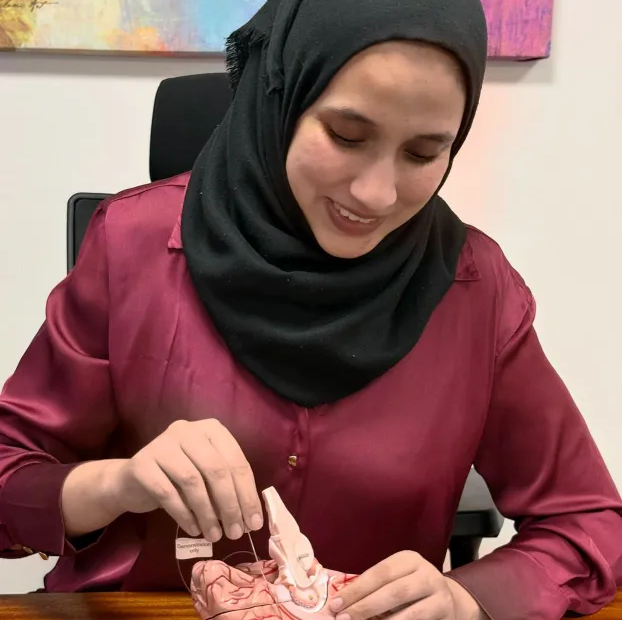
On Monday a multidisciplinary team at Mediclinic Constantiaberg, in Cape Town, will perform the first stereo-EEG procedure in South Africa and sub-Saharan Africa. The first patient is a 43-year-old man whose seizures began a little over a year ago. The technique places fine electrodes deep inside the brain to find exactly where a person’s seizures start, so that surgery can be offered to patients whom medication has failed.
For most people with epilepsy, the correct medication brings seizures under control but for about one in three, it does not.
They try one tablet, then a second, then a third, often with side effects that can be almost as disabling as the seizures.
Once two well-chosen medications have failed, the chance that another will stop the seizures is very small.
For some of these patients there are other options, including surgery. If doctors can find the area of the brain where seizures begin, removing or treating it can stop them altogether.
The difficult part, however, is finding this exact spot.
Stereo-EEG (SEEG) is now the international standard for locating where seizures start in patients being considered for epilepsy surgery.
Apart from in Egypt recently, this procedure is not performed anywhere else on the continent.
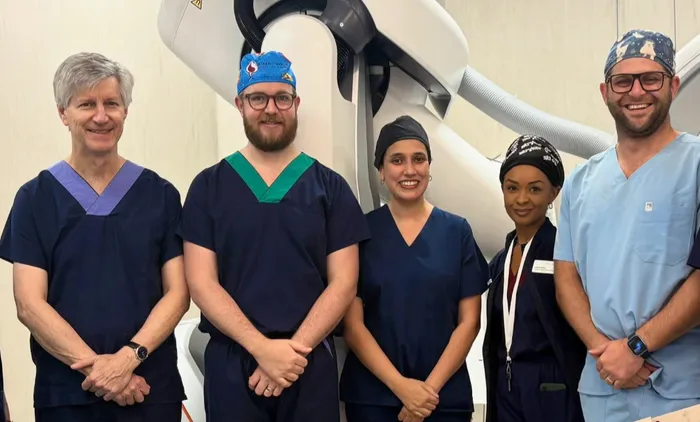
Image: SUPPLIED
First patient
The first patient is a 43-year-old man whose seizures began a little over a year ago.
In that short time, they have affected his work and family life and taken away his ability to drive. Several anti-seizure medications have failed to control them, and their side effects have added to the burden.
“This is exactly the kind of patient SEEG was designed for,” said epileptologist Dr Aayesha J Soni, who is leading the programme.
“His seizures start in one part of the brain, and medication has not worked. The question is no longer which tablet to try next. It is where his seizures come from, and whether we can safely do something about it.”
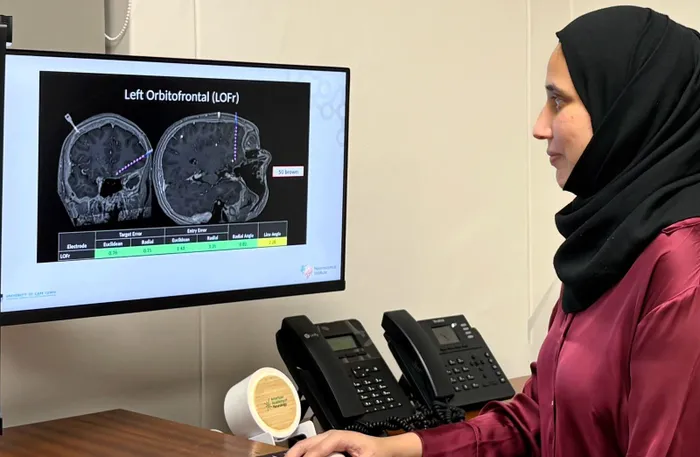
Image: SUPPLIED
Listening from the inside
A standard EEG (electroencephalogram) records the brain’s electrical activity through small electrodes on the scalp.
It is an essential test, but the skull muffles the signal, and seizures that begin deep in the brain can be impossible to pin down from the outside. It is a bit like listening to a football match from outside the stadium, where you hear the roar when something happens, but not where on the field.
SEEG puts the microphones inside. Using detailed brain scans, the team plans the path of each electrode in advance so that it avoids blood vessels and vital structures.
In theatre, a stereotactic frame fixed to the patient’s head guides the neurosurgeon to place each electrode with millimetre accuracy.
The thin electrodes pass through tiny holes in the skull, so the skull is never opened.
The patient is then monitored around the clock, sometimes for a week or more. Medication is carefully reduced so that seizures can be recorded safely.
The team can see where a seizure starts, how it spreads and which parts of the brain are involved. Gentle electrical stimulation through the same electrodes maps the areas that control speech and movement, so that any later surgery protects them.
The electrodes are then removed, without a second operation.
“SEEG gives us a three-dimensional picture of a person’s epilepsy,” said Dr Soni.
“The purpose of the implantation is for it to show us the area we can remove, in which case the patient has a real chance of becoming seizure-free. Sometimes it tells us surgery is not safe.
“That is also valuable, because we can move on to other treatments instead of leaving someone in limbo,” she added.
More than a year in the making
The implantation takes a couple of hours, but getting to this point has taken more than a year of planning at MediClinic Constantiaberg.
SEEG is the end point of a long, structured presurgical pathway, and it depends on many people including epileptologists (neurologists specialised in epilepsy) where Dr Soni works with Dr James Butler, a neurosurgeon, Dr Sean Tromp, neurophysiologists and EEG technologists, neuropsychologists, radiologists, anaesthetists, theatre and ward nurses, and technical and engineering partners.
The team trained in the technique, sourced specialised electrodes and equipment, wrote protocols based on international guidelines and the practice of leading epilepsy centres, and secured funding approvals from medical schemes.
Expanded EEG monitoring at the hospital was essential, because every SEEG patient needs extensive scalp recordings beforehand and close monitoring afterwards.
“Nobody does this alone,” said Dr Soni.
“Every person involved has spent months preparing for this.
SEEG is well established internationally, and that, together with our preparation is what makes it safe. It is a pioneering service for South Africans and Africans,” she added.
What it means for Africa
Epilepsy affects around 50 million people worldwide, and nearly 80% of them live in low- and middle-income countries.
Epilepsy is more common in sub-Saharan Africa than in Europe, Asia or North America, yet most people here who need treatment never receive it.
Stigma remains a major barrier, where myths that epilepsy is contagious or a sign of moral failing still stop people from seeking help and cost many their jobs, schooling and relationships.
Until now, South Africans who needed SEEG had to travel abroad, which put it out of reach for almost everyone.
“Having the skills and the team here changes that. It also sends an important message that epilepsy is a medical condition that can be investigated and, in many cases, treated and even cured.
“Every time we show that, we chip away at the stigma. The next step is making sure this care is not available to only a few. People with epilepsy deserve the best care, wherever they live and whatever their means,” said Dr Soni.
“Reprinted from….”Dr Aayesha Soni leads pioneering SEEG epilepsy procedure in South Africa