
By Ramzy Baroud
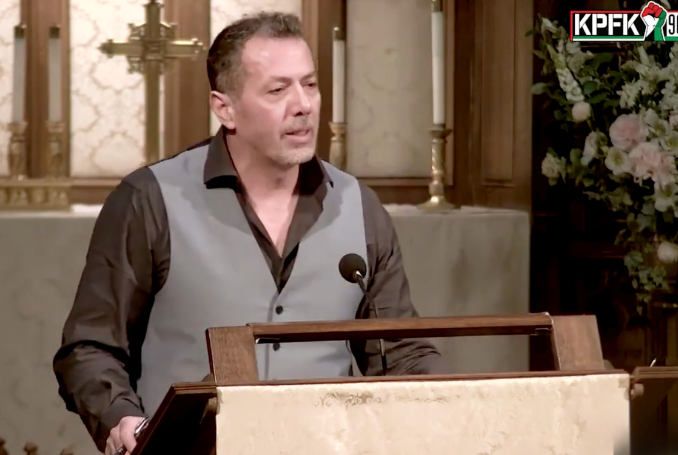
At a KPFK event in Los Angeles on May 9, Ramzy Baroud reflects on storytelling as an act of sumud, tracing the intimate relationship between memory, exile, resistance, and the struggle to preserve Palestinian humanity through words.
Why do we write books?
Why do we tell stories?
Why do we insist on narrating ourselves, even when the world seems unwilling to even listen, or worse, when it has already decided what our story ought to be?
For most people, these questions may appear philosophical, even abstract. They belong to the realm of intellectual curiosity, of literary reflection.
But for Palestinians, these are not abstract questions.
They are urgent, lived, and deeply existential.
They are questions about survival—not merely physical survival, but survival as a people with memory, with history, with a sense of self that cannot be reduced, simplified, or erased.
We tell stories because we must remember ourselves. Not only as individuals, but as a collective—bound across generations by fragments of memory, by inherited grief, by shared resilience, and by a stubborn refusal to disappear.
We tell stories so that our children, and their children, may trace the thread of who we are – even when that thread has been violently stretched across exile, shatat, war, and displacement.
In Before the Flood, I tried to articulate this idea by challenging the conventional understanding of history itself.
History, I wrote, is not simply a record of events—dates, wars, agreements, the births and deaths of supposedly ‘great individuals’—but rather “the sum of feelings; the culmination of ideas; the evolution of collective consciousness, identities, and relationships; and the subtle changes occurring in societies over the course of time.”
This distinction is crucial because if history is reduced to events alone, then entire peoples can be erased simply by omitting them from the official record.
But if history is understood as something lived, something carried in memory and consciousness, then it becomes far more resilient.
It cannot be so easily destroyed.
For Palestinians, history is not stored in archives. It lives in stories—told and retold, sometimes in fragments, sometimes in whispers, oftentimes in defiance.
It lives in the way a grandmother recalls a village that no longer exists, describing its orchards, its markets .. its rhythms of life – as if it were still standing.
It lives in the way names are passed down, generation after generation, as if each name carries within it an entire narrative that refuses to fade.
We also write because there are those who have invested immense effort in ensuring that we are forgotten.
The attempt to erase Palestinians has never been limited to geography. It has always extended to narrative. To history. To memory itself.
This is why Golda Meir could state, with unsettling confidence, that “there was no such thing as Palestinians.”
This was an articulation of a broader logic—one that sought to deny the existence of a people in order to justify their displacement. In fact, their extermination.
This logic persists, though it often takes more subtle forms.
Today, Palestinians are rarely denied outright. Instead, they are reframed. Reduced. Transformed into abstractions—statistics, humanitarian cases, political problems to be managed rather than a people to be understood.
Politicians, but also many academics, speak of Palestinians in terms that strip away their historical and political depth, reducing their struggle to economic opportunity or administrative inconvenience.
In such frameworks, the question is not one of justice or rights, but of management—how to contain, how to stabilize, how to integrate Palestinians into a system that was never designed to accommodate their existence as equals.
Yet what is perhaps even more troubling is that this reduction is not limited to adversaries. It is often reproduced, albeit unintentionally, at times, by those who claim solidarity.
Within many dominant narratives, Palestinians are permitted to exist only as victims. Their suffering is acknowledged, even highlighted, but their agency is constrained.
They are seen, but not truly heard;
They are represented, but not allowed to truly define themselves.
In this narrative, Palestinian history begins not with Palestinians, but with external events—the First Zionist Congress, the Balfour Declaration, the establishment of Israel, and so on.
Palestinians enter history only as objects of these processes, never as subjects in their own right.
This framework strips Palestinians of historical continuity. It suggests that their existence is reactive, contingent, secondary.
That their identity emerges only in response to colonialism, rather than preceding it by centuries, in fact millennia.
But this is not how Palestinians understand themselves.
In Before the Flood, I resisted this imposed framework by telling the story of a family—not as an isolated narrative, but as a window into a much longer historical continuum.
The story begins in Beit Daras, a village that, like hundreds of others, was destroyed during the Nakba.
EXCERPT 1
When Ibrahim and his wife took their children and fled Beit Daras for the last time, it was engulfed in smoke, gunfire, explosions, and the screams of dying villagers.
At first, he thought Hamameh would be safer for a short stay. He trusted, like most Palestinians, that they would all soon return home.
But, a few days later, Hamameh and all the villages around Beit Daras fell, one after the other, to advancing Zionist militias.
Since Yafa, one of the closest major cities, had already fallen, the only rational path was to flee south to Gaza, where the Egyptian army remained strong and most of the survivors of the ongoing onslaught were gathering.
After a few days’ journey, the family arrived at Shujaiyeh. The old Gaza neighborhood overflowed with desperate refugees seeking food and shelter.
Beit Daras was not an abstract place. It was a living community, shaped by centuries of history. Its fields, its homes, its social structures—all reflected a continuity that long preceded the arrival of Zionism.
The village existed within a broader historical landscape shaped by successive empires—the Ottomans, the Mamluks, and earlier civilizations, but most importantly by the indigenous inhabitants of Palestine themselves.
Each empire left traces, but none erased the fundamental continuity of Palestinian life. The villagers adapted, resisted, and endured, maintaining their social and cultural fabric despite external pressures.
This continuity is essential to understanding Palestinian identity today.
It reveals that Palestinians are not merely the product of modern political developments, but part of a much deeper historical trajectory—one that cannot be reduced to a single moment or event.
This brings us to the question of agency.
Are Palestinians merely victims of history, or are they active participants in shaping it?
The answer, though often obscured, should be clear.
Palestinians have always exercised agency, though not always in ways that are easily recognized within dominant frameworks.
Their agency is embedded in everyday acts of resilience—in the decision to remain, to rebuild, to remember. It is reflected in a deeply ingrained culture of resistance, one that is not reactive but generative, not imposed but inherited.
In the book, this continuity is captured through the concept of longue durée—’long duration’: the idea that history unfolds not only through events, but through long-term structures of thought, behavior, and collective consciousness.
Palestinians, I argue, are shaped by such a long-term trajectory, one that is rooted in memory, in shared experience, and in a collective commitment to survival.
This is why Palestinian resistance cannot be understood as a series of isolated reactions. It is part of a much larger historical process—one that connects past, present, and future in a continuous narrative.
EXCERPT 2
Gaza’s resistance throughout history has been linked to Palestinians themselves, not to the specific heroic figures we encounter now and then.
We know this because of the consistency of the collective resilience of the Palestinians often invoked in the word sumud, which does not seem to be linked to any specific period, mode of thinking, or religious belief.
Otherwise, how can one explain the Gazans’ legendary resistance against the Romans, the Crusaders, Napoleon’s military campaign, the British and, finally, Israeli settler-colonialism.
The perplexing thing in all of this is that in terms of its topographic formation, Gaza was never truly ready for these kinds of wars and sieges.
A flat, small coastal area, it was always vulnerable to invaders who attacked from the sea, charged from the desert, and converged from every direction. Yet Gaza and the rest of Palestine always found a way to resist.
To fight Alexander, Gazans built artificial hills from mounds of dirt. In later wars, they dug massive trenches. When modern warfare made these tactics ineffectual, they dug tunnels.
Geography and landscape can be a blessing or a curse to those fending off foreign invasions, but an ingredient far more precious is required for resistance to matter: the human spirit.
The same factor which compelled Batis and his people to fight Alexander with the determination to vanquish the ruthless Macedonians compelled Ehab to dig tunnels all around his Shati refugee camp in order to keep the enemy at bay.
But beyond these conceptual frameworks, there is something more immediate, more personal, and more difficult to articulate.
There is a reason we tell stories that goes beyond theory, beyond academic language, beyond even political necessity.
We tell stories because we must survive, and proudly so.
In the course of writing Before the Flood, I was confronted with the profound reality that storytelling itself had become an act of survival.
Entire families were being erased—killed, displaced, scattered—yet their stories persisted, carried forward by those who remained.
This persistence is not accidental. It reflects a deliberate, collective effort to resist erasure—not through force, but through memory.
In my own family, loss has been immense. Generations have experienced displacement, violence, and death. Yet within this loss, there is also continuity.
During the genocide in Gaza, my family was shattered.
Over one hundred members of my immediate and extended family were killed.
Not distant names.
Not statistics.
People whose lives were intertwined with mine in ways that cannot be fully explained.
Children.
Women.
Doctors.
Teachers.
My sister.
EXCERPT 3
I struggled to define the single most critical event in our history, if any existed, that could serve as the starting point of our historical trajectory.
This is when my sister Soma, one of Gaza’s most beloved medical doctors, was assassinated by the Israeli army on October 9, 2024, while on her way back from Al-Nasser Hospital in Khan Yunis.
I say assassinated because she was the 166th doctor and 987th medical worker to be deliberately killed by Israel up to that date, part of the Israeli plan to annex our land and dismantle all aspects of Palestinian life and societal continuity.
After days of mourning, it dawned on me that Soma, in her beauty, cleverness, wisdom, patience, and, yes, courage and sacrifice, had always represented the single moment that demarcated the history of our people.
Soma, or the representation of all the Somas of our history—including the history yet to be written— gives us meaning, inspires us, and grants us hope and courage.
But even during periods of profound destruction and loss, new children are born. They are given the names of those who were lost, not merely as a gesture of remembrance, but as a continuation of their legacy.
This practice reflects a fundamentally different relationship with history. For Palestinians, history is not a distant past. It is a living presence, carried forward through names, through stories, through the very fabric of everyday life.
This continuity extends beyond individuals to cultural practices as well.
Consider tatreez—Palestinian embroidery. Its patterns are intricate, symbolic, and deeply rooted in history. Yet many who wear these patterns cannot fully explain their meanings.
They inherit them, just as they inherit their names, cultural references, customs, and collective memory.
This inheritance is not passive. It is an act of preservation, of transmission, of continuity. It reflects a deeper understanding of history—not as something to be analyzed from a distance, but as something to be lived, embodied, and carried forward.
It is within this context that we must understand the resilience of the Palestinian people.
Their strength does not lie in military power, nor in political institutions, nor even in intellectual discourse alone.
It lies in something far more fundamental—a collective consciousness shaped by memory, by shared experience, by an unwavering commitment to existence.
History, therefore, is ultimately shaped not by weapons, but by “ideas, memories, and communal aspirations.”
This is the foundation of Palestinian resilience.
It is also the reason why Palestinians cannot be easily defeated.
Not because they possess superior power—but because they are anchored in something that cannot be destroyed.
A collective code.
A shared understanding of who they are, where they come from, and why they must continue.
And this, ultimately, is why we write.
We write to remember.
We write to resist.
And we write to survive.
But above all, we write to assert that we exist—not as abstractions, not as victims, not as footnotes in someone else’s history, or story—but as a people with our own narrative, our own continuity, and our own unbroken presence in the world.
And as long as that narrative continues to be told, in whatever form, by whatever means, the attempt to erase us will never succeed.
EXCERPT 4
The killing of new members of his family added a new dimension to Ehab’s struggle against Israel.
The crushed bodies he had salvaged from the rubble and buried with his own hands revitalized the past, all of it: The original Nakba, as conveyed by Madallah’s many painful stories and demonstrated in the everyday life of the refugee camp, began to take on a real form.
The Nakba was no longer in the past. It was now. It became immediate. Urgent. Raw. Deadly. While many around the world were beginning to speak of the “New Nakba,” Ehab felt it in the bodies he had buried, the burning smoke of flesh he breathed, and the unfathomable destruction he had witnessed.
But for Ehab, this new or continued Nakba was not an historical or intellectual notion for study and consideration. It was his life. His past, his present, and, at least in his own mind, his sealed fate as well.
There was nothing that Ehab could have said or done to alter the Nakba of 1948 or its outcome. This time, however, he felt that he had options.
Unlike his son, Abdulrahman, he could not scale high walls, leap over mountains of rubble, or wedge himself through the smallest of tunnels.
But Ehab was still a warrior, because, as he often argued, courage can never be degraded by age.
And this—this is precisely where the story begins.
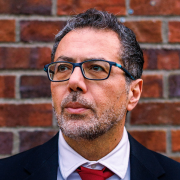
– Dr. Ramzy Baroud is a journalist, author and the Editor of The Palestine Chronicle. He is the author of eight books. His latest book, ‘Before the Flood,’ was published by Seven Stories Press. His other books include ‘Our Vision for Liberation’, ‘My Father was a Freedom Fighter’ and ‘The Last Earth’. Baroud is a Non-resident Senior Research Fellow at the Center for Islam and Global Affairs (CIGA). His website is www.ramzybaroud.net
“Reprinted from…”https://www.palestinechronicle.com/why-do-we-tell-stories-ramzy-baroud-on-writing-as-resistance-memory-and-survival/