
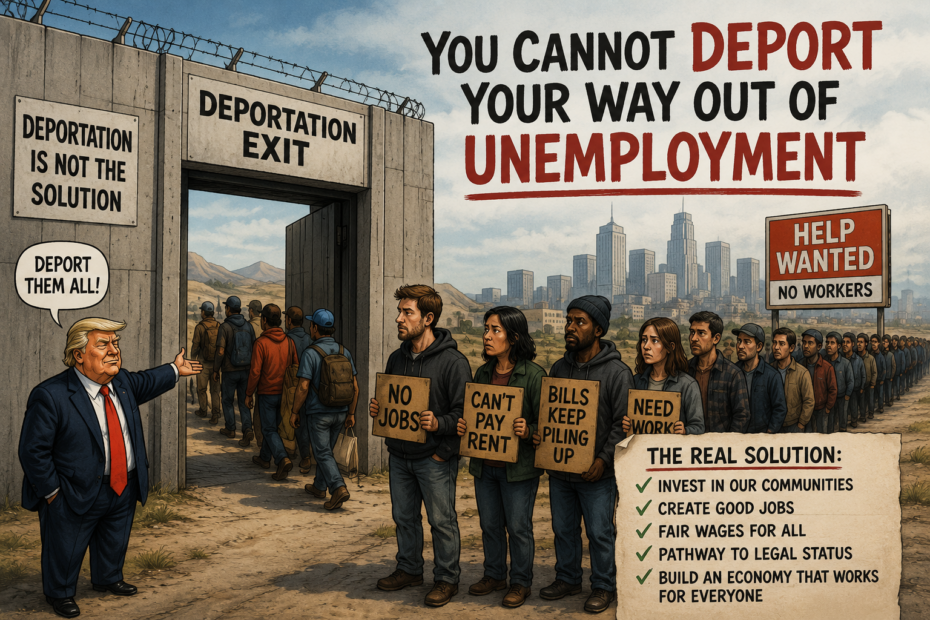
President Cyril Ramaphosa’s recent address on illegal immigration was intended to reassure South Africans that government is responding decisively to growing concerns about undocumented migration, border security, and economic exclusion.
The President argued that illegal immigration undermines efforts to create decent work for South Africans. He announced a series of measures, including increased deportations, specialised immigration courts, stronger border controls, the recruitment of 10,000 labour inspectors, and the implementation of the Employment Services Amendment Bill, which would empower government to set quotas on the employment of foreign nationals in certain sectors.
Yet despite the extensive focus on immigration, the speech revealed a deeper problem: government appears to be treating immigration policy as a substitute for economic policy.
South Africa’s greatest challenge is not migration. It is unemployment.
The country faces a severe labour crisis, leaving over 8.1 million people without work. Nearly 44% of the extended labour force is either unemployed or has given up actively seeking work, while youth unemployment remains at critical levels. They are not marginal statistics—they define the lived reality of South Africa’s economic crisis.
By contrast, South Africa is home to an estimated 2.4 to 3.1 million foreign-born residents, accounting for roughly 3.9% to 5.1% of the population. These figures include both documented and undocumented individuals. Even at the upper end, migrants make up a relatively small share of the population compared to the scale of unemployment. The real question is therefore not whether migration should be managed, but whether a structural unemployment crisis of this magnitude can realistically be solved through immigration enforcement — or whether it demands serious economic transformation.
The question facing South Africa is not simply who is working in the country. It is why the economy continues to fail to generate sufficient employment opportunities for its people.
Supporters of the Employment Services Amendment Bill argue that South Africans should be prioritised in a labour market marked by mass unemployment. This concern is understandable. In a country where millions are without work or have been pushed out of the labour market entirely, government has a responsibility to ensure citizens are not excluded from economic opportunities.
However, restricting the employment of foreign nationals does not automatically create jobs for South Africans.
Employment is not generated through quotas. It is generated through investment, economic growth, entrepreneurship, industrial expansion, and business confidence.
A company does not hire additional workers simply because government limits the number of foreign employees it may employ. Businesses create jobs when they expand operations, enter new markets, increase production, and invest in growth.
The danger is that immigration becomes a convenient political explanation for economic failures that have far deeper roots.
South Africa’s unemployment crisis was not caused by migrants. It was not caused by asylum seekers. It was not caused by foreign-owned spaza shops.
The country’s economic difficulties stem from years of weak growth, infrastructure failures, electricity shortages, corruption, declining investor confidence, and inadequate support for small and medium-sized businesses.
These are difficult problems to solve. Immigration enforcement is not.
That is why government’s priorities deserve scrutiny.
The President announced the recruitment of 10,000 labour inspectors to strengthen enforcement against employers who hire undocumented workers. Government is also expanding immigration enforcement operations, establishing specialised immigration courts, strengthening border management systems, and implementing new regulatory frameworks governing the employment of foreign nationals.
Yet South Africans are entitled to ask whether the same level of urgency is being applied to creating jobs.
Where is the equivalent large-scale programme to support entrepreneurs? Where is the ambitious plan to stimulate labour-intensive industries? Where is the urgency around accelerating economic growth, reducing barriers to investment, and rebuilding infrastructure capable of supporting employment creation?
The government’s response to unemployment increasingly appears focused on regulating who may work rather than expanding the number of jobs available.
This is not an argument against immigration regulation. Every sovereign state has the right to manage its borders and enforce its laws.
But migration policy should complement economic policy, not replace it.
South Africans are not demanding more compliance measures. They are demanding opportunities. They are demanding jobs. They are demanding an economy capable of delivering dignity through work.
The true measure of success will not be how many deportations are carried out, how many inspections are conducted, or how many foreign workers are excluded from particular sectors.
It will be whether more South Africans are employed next year than they are today.
At its core, unemployment is not an immigration problem. It is an economic problem.
And economic problems require economic solutions.
South Africa cannot regulate its way to prosperity. It cannot inspect its way to growth. And it certainly cannot deport its way out of unemployment.
What the country needs most is not another immigration strategy.
It needs a jobs strategy.
Sõzarn Barday is a South African lawyer and author focusing on human rights, international law, and geopolitical events in the Middle East. The views expressed are her own.