
By Iqbal Jassat
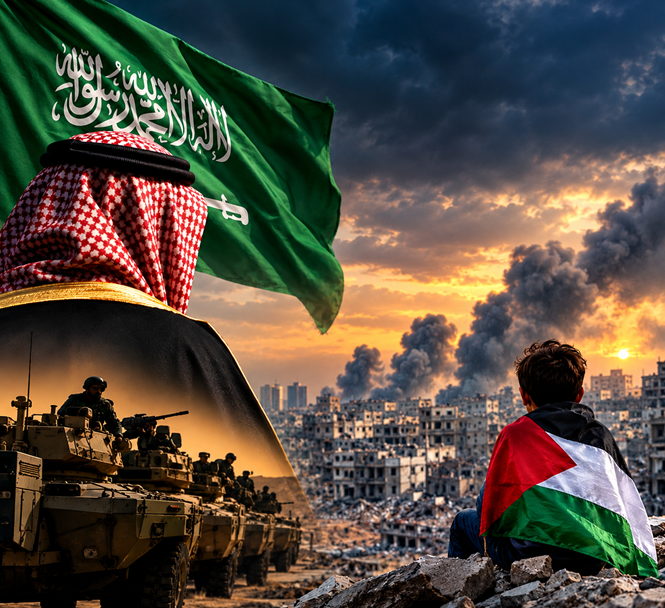
For decades, the Saudi regime has manicured its image as the undisputed leader of the Arab and Islamic worlds by shrewdly leveraging its custodianship of Mecca and Media.
Alongside its staggering wealth, Riyadh has long projected itself as a fortress of Muslim solidarity.
Yet, Israel’s ongoing horrific and ruthless genocide in the Gaza Strip and the unchecked, atrocious ethnic cleansing across the Occupied West Bank have permanently shattered this illusion.
As history records one of the most televised atrocities of the modern era, the House of Saud’s response will forever stand as a testament to calculated inaction—a policy of absolute complicity disguised as diplomatic neutrality.
The depth of this betrayal has been meticulously laid bare by investigative critiques, most notably in Untold Mag’s seminal expose, “Blood, Oil, and Silence: Saudi Arabia’s Role in War Crimes From Yemen to Gaza.”
The core indictment against Riyadh is not merely its failure to intervene militarily to halt the slaughter of Palestinians, but its active maintenance of the economic and strategic pipelines that sustain the status quo.
While Palestinian children pull their families from the rubble, Saudi Arabia has deliberately kept its oil flowing through vital infrastructure like the SUMED pipeline, ensuring that resources continue to reach Western markets and fuel military operations indirectly linked to the ongoing genocide.
The historical contrast is damning. In 1973, King Faisal famously wielded the oil embargo as a devastating political weapon to force Western powers to halt aggression against Arab lands.
Today, under the de facto rule of Crown Prince Mohammed bin Salman (MbS), that leverage has been completely abdicated.
When pressed on whether an oil embargo could be deployed to halt the Gaza slaughter, Saudi Investment Minister Khalid al-Falih infamously dismissed the idea with a laugh, declaring that it was “not on the table today.”
This systemic abandonment extends into the financial realm: the Saudi Public Investment Fund (PIF) continues to retain massive stakes in US defense contractors and channels capital into Israeli-linked tech and defense ecosystems.
By maintaining these financial and strategic networks, the Saudi regime has effectively chosen to profit from the very empire that bankrolls the annihilation of Palestine.
What makes Riyadh’s military paralysis in Palestine so grotesque is that it does not stem from a lack of capability or a newfound pacifism. The Saudi regime has proven itself entirely willing to mobilize immense military and diplomatic resources when its own dynastic interests or regional hegemony are threatened.
One need only look across the border to Yemen, where the Saudi-led coalition enacted a brutal, years-long military intervention defined by starvation blockades and mass civilian casualties.
More recently, this selective aggression has been codified on the global stage. Riyadh has masterminded the Mecca Joint Defense Agreement, a NATO-inspired security pact designed to rally international forces to its side. MbS has aggressively mobilized powerful non-Arab allies, specifically Pakistan and Turkey, to form a united military front.
The explicit target of this newly minted coalition? Ansarullah (the Houthis) in Yemen.
Ansarullah has actively engaged in the Red Sea as part of the regional “Axis of Resistance,” utilizing maritime blockades to disrupt shipping to Israel in a direct, material attempt to force a ceasefire in Gaza. Rather than supporting or even quietly permitting these efforts to choke the Israeli economy, the Saudi regime has mobilized foreign armies to crush them.
Reports even suggest a quiet, behind-the-scenes intelligence cooperation between Saudi Arabia and Israel to counter the Houthis.
Riyadh is willing to build military coalitions with Turkey and Pakistan to protect trade routes and suppress anti-Zionist resistance, yet it cannot spare a single round of ammunition, a single diplomatic sanction, or a single barrels’ worth of oil pressure to defend Masjid Al-Aqsa or the Occupied population of the West Bank.
Domestically, the regime’s actions are just as repressive. To prevent the inevitable swell of public fury from threatening the throne, the Saudi state has instituted a zero-tolerance policy against any form of pro-Palestinian dissent.
Citizens and residents face draconian prison sentences simply for expressing solidarity with Palestine online or criticizing normalization efforts.
MbS has deployed billions of dollars into global sports, entertainment, and PR campaigns to launder the Kingdom’s image, attempting to distract the world from both its internal human rights abuses and its external betrayal of the Palestinian cause.
True leadership is defined in moments of existential crisis. By prioritizing financial alignment with Washington, safeguarding secret intelligence ties with Tel Aviv, and mobilizing military pacts against the regional resistance, the Saudi regime has made its allegiance clear. It has traded the blood of Palestinians for a seat at the table of global empire.
Mohammed bin Salman’s legacy will not be one of modernization or reform; it will be permanently defined by the deafening silence and active complicity of a kingdom that watched a genocide unfold and chose to protect the perpetrators.
Iqbal Jassat
Executive Member
Media Review Network
Johannesburg
South Africa